
What Is a Behavioral Health Residential Facility (BHRF) in Phoenix — and How Is It Different From an Unlicensed Sober Living Home?
If you are searching for a safe residential placement for an adult loved one in Phoenix who is struggling with a serious mental health condition, you have probably already noticed that the landscape is confusing. Group homes, sober living houses, behavioral health residences, transitional homes — they can all sound similar. Some look professional online. Some even use clinical-sounding language in their marketing. But the differences between a licensed Behavioral Health Residential Facility (BHRF) and an unlicensed sober living home are not just technical details. They are the difference between structured clinical care with psychiatric oversight and a shared house with minimal accountability and no treatment whatsoever. For families in Phoenix and across Maricopa County trying to make a fast, safe decision for someone they love, understanding this distinction may be the most important first step you take.
What Is a Licensed BHRF — and Who Regulates It in Arizona?
A Behavioral Health Residential Facility, commonly called a BHRF, is a residential treatment setting licensed by the Arizona Department of Health Services (ADHS). That license is not automatic or decorative — it represents a rigorous review of the facility’s clinical staffing, physical environment, safety protocols, treatment programming, and compliance with state behavioral health standards.
In Arizona, licensed BHRFs must comply with AHCCCS — the Arizona Health Care Cost Containment System, which is Arizona’s Medicaid program — AMPM Policy 320-V. This is a detailed set of requirements governing how residential behavioral health services are delivered, documented, and billed. A facility operating under this compliance framework must provide 24-hour supervision, individualized treatment planning, psychiatric oversight, medication management, and structured therapeutic programming. It must maintain clinical records and submit to ongoing monitoring by both ADHS and AHCCCS.
This is the environment where real treatment happens. Where a psychiatrist reviews your loved one’s medications. Where a licensed clinician develops an individualized plan. Where staff are trained to respond to behavioral crises without calling 911 as a first resort. Behavioral health residential treatment at a licensed BHRF is a measurable, accountable level of care — not just a roof over someone’s head.
What Is an Unlicensed Sober Living Home — and Why Does the Distinction Matter in Phoenix?
Sober living homes occupy a very different category. Most are not licensed by ADHS as behavioral health facilities. They are typically peer-run or privately operated residences where adults in recovery from substance use can live together in a structured, alcohol- and drug-free environment. In their proper role, sober living homes can be a genuinely useful step-down resource after treatment — a bridge between residential care and fully independent living.
The problem in the Phoenix market, and it is a well-documented one, is that not all sober living homes operate with that kind of integrity. Some homes market themselves in ways that blur the line between peer support housing and clinical treatment. They may advertise services like counseling, case management, or mental health support without any licensed clinical staff on-site and without any regulatory oversight requiring them to deliver what they promise. Families who are scared and searching fast — often after a psychiatric hospitalization in Glendale or Mesa, or following a crisis in South Phoenix — can end up placing a loved one in an unlicensed home believing they are getting treatment, when in fact they are getting very little.
This is not a minor gap. For an adult living with schizophrenia, schizoaffective disorder, bipolar disorder with psychosis, or severe depression, a setting without psychiatric oversight and structured clinical care is not just inadequate — it can be dangerous. Medications lapse. Crises escalate without trained intervention. The person cycles back into emergency rooms, and the family starts over.
How to Tell the Difference Before You Place a Loved One
When you are evaluating a residential placement in Phoenix or anywhere in Maricopa County, here are the specific questions that will tell you what you are actually looking at:
- Is the facility licensed by ADHS as a Behavioral Health Residential Facility? Ask directly, and then verify. ADHS maintains a public licensing database you can search by facility name.
- Is the facility AHCCCS-contracted? If it accepts AHCCCS (Arizona’s Medicaid program), it must meet and maintain a higher compliance standard than a non-contracted facility.
- Is there a licensed psychiatrist or nurse practitioner on-site or available for psychiatric oversight? A sober living home will almost never be able to say yes to this.
- Does the facility provide individualized treatment plans? A licensed BHRF is required to do this. A sober living home is not.
- What happens when a resident has a psychiatric crisis at 2 a.m.? At a licensed BHRF, staff are trained and protocols are in place. The answer should be specific, not vague.
- Is the facility accredited by a recognized external body such as The Joint Commission or CARF? This is an additional but meaningful layer of accountability.
If the answers to these questions are evasive, or if a facility’s intake team cannot clearly explain what license they hold and who their clinical staff are, that is important information. You deserve straight answers before a placement decision is made.
Why This Confusion Is So Common — and So Hard on Families
Part of what makes this difficult is that Phoenix has a high volume of residential facilities across the housing and behavioral health continuum, with relatively limited licensed BHRF bed capacity relative to the need. Demand across Maricopa County for licensed, AHCCCS-contracted BHRF beds is consistently high. When families are told beds are unavailable at licensed facilities, it can be tempting to consider alternatives that sound similar but are operating under entirely different rules.
Families in Tempe, Peoria, and throughout the metro area also often arrive at this decision in crisis — after a hospitalization, after a dangerous incident at home, after weeks or months of watching a loved one deteriorate. In those moments, the instinct is to find something fast. Predatory or simply inadequate operators know this, and some market aggressively to families in exactly that vulnerable state.
The most important thing to know is this: taking an extra few hours to verify a facility’s licensure before placement is always worth it. A placement in an unlicensed setting rarely ends the crisis — it usually just delays the next one.
What Bougainvillea Manor Offers — and How We Are Different
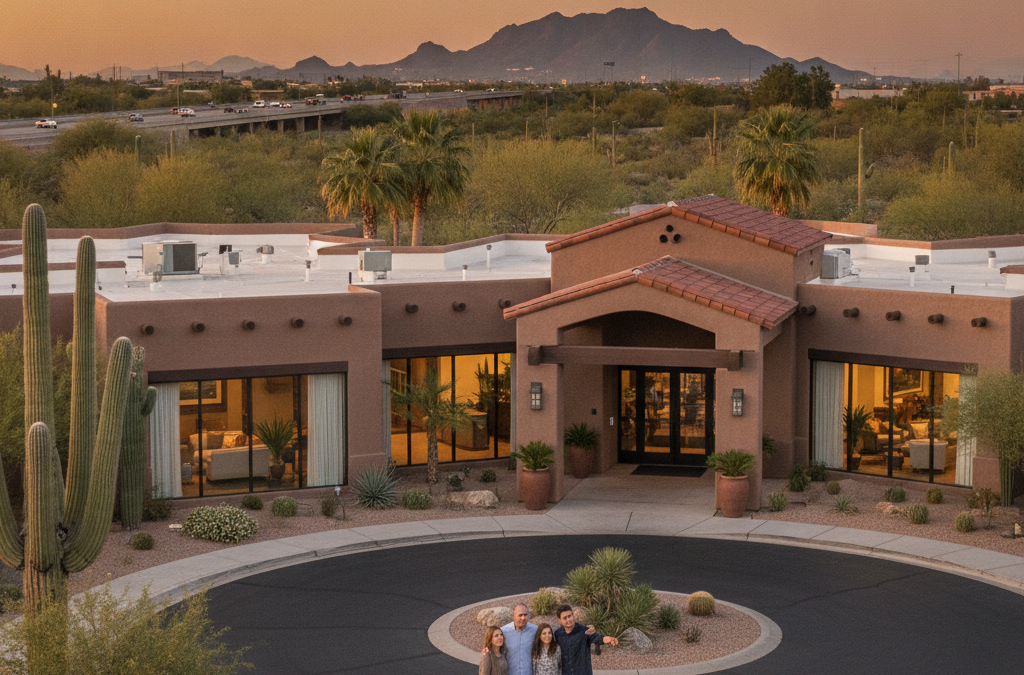
Bougainvillea Manor Behavioral Health is a licensed BHRF located in Phoenix, serving adults across Maricopa County. We are licensed by ADHS and contracted with AHCCCS, which means our care standards are externally regulated — not self-reported. Our clinical team includes licensed behavioral health professionals and psychiatric oversight, and every resident receives an individualized treatment plan developed collaboratively from the time of admission.
We treat adults living with serious mental health conditions including depression, generalized anxiety disorder, bipolar disorder, PTSD, schizophrenia, schizoaffective disorder, and personality disorders. For adults with co-occurring substance use, our dual diagnosis treatment addresses both conditions together rather than treating them as separate problems.
We work closely with referral partners including hospitals, Regional Behavioral Health Authorities (RBHAs — the state-contracted organizations that manage AHCCCS behavioral health services in each region), Adult Recovery Teams (ARTs), and Child and Family Teams (CFTs). If you are a case manager or discharge planner, we can walk you through our authorization and intake process directly.
Frequently Asked Questions
How do I verify that a facility in Phoenix is a licensed BHRF?
You can search the ADHS public licensing database online by facility name or address. You can also ask the facility directly for their ADHS license number and call ADHS to confirm. Any licensed BHRF should be able to provide this information immediately and without hesitation.
Can a sober living home bill AHCCCS for behavioral health services?
No. To bill AHCCCS for residential behavioral health services, a facility must be licensed as a BHRF and contracted with AHCCCS. An unlicensed sober living home cannot legally bill AHCCCS for clinical services. If you are told otherwise, that is a serious warning sign.
What if my loved one needs both mental health treatment and substance use support — does a BHRF cover that?
Yes. A licensed BHRF that provides integrated dual diagnosis treatment can address co-occurring mental health and substance use disorders together. This is actually preferable to treating them separately, because the two conditions are almost always connected and each affects the other.
Does Bougainvillea Manor accept AHCCCS / Medicaid?
Yes. We accept AHCCCS/Medicaid as well as some commercial insurance plans. If you are unsure about your loved one’s coverage, our admissions team can help you verify benefits before a placement decision is made. You can also visit our insurance page to learn more about what we accept.
Do sober living homes ever play a legitimate role in recovery?
Yes — when used appropriately. A reputable sober living home can be a meaningful step-down resource after a person has completed a course of residential treatment and is transitioning toward independent living. The concern is when sober living is used as a substitute for clinical treatment rather than a complement to it, especially for adults with serious, untreated mental illness.
Take the Next Step — Get Clear Answers Before a Placement Decision
If you are a family member trying to find safe, licensed residential mental health care for an adult in Phoenix or anywhere across Maricopa County, you do not have to navigate this alone. Our admissions team at Bougainvillea Manor Behavioral Health is available to answer your questions directly — including questions about our licensure, our clinical staff, our treatment approach, and how AHCCCS authorization works. We will never pressure you, and we will give you honest answers about what we offer and whether we are the right fit.
Reach out today through our contact page or call us at 866-248-6266. The first conversation is free, and it may be the clearest one you have had in a long time.