How Does Residential Mental Health Treatment in Phoenix Address Loneliness and Social Isolation — and Why Reconnecting Matters for Long-Term Recovery
If your loved one has been withdrawing from everyone — staying in their room, not answering calls, letting relationships quietly fall away — you may already sense that something serious is happening. In Phoenix and across Maricopa County, social isolation is one of the most common — and least talked about — warning signs that a person’s mental health has reached a point where outpatient support alone may not be enough. The good news is that residential mental health treatment does more than stabilize symptoms. Done well, it directly addresses the disconnection that both fuels and follows mental illness — and it starts building the relational skills that make long-term recovery possible.
Why Loneliness and Mental Illness Feed Each Other
Loneliness is not a personal failing. For adults living with depression, bipolar disorder, schizophrenia, PTSD, or a personality disorder, pulling away from other people often feels like the only way to survive. Socializing takes energy that the illness has already drained. It requires trust that trauma has eroded. It demands consistency that unstable moods make nearly impossible.
Over time, that withdrawal creates a cycle. The less connected a person is, the more their mental health suffers — and the worse their mental health, the harder connection becomes. Research consistently shows that chronic social isolation is associated with worsening depression, higher rates of psychosis relapse, and increased risk of crisis. For families watching from the outside, the isolation itself often becomes the clearest sign that something has to change.
This is a dimension of mental health recovery that many local providers address only superficially. Group therapy appears on a program schedule, and peer support gets mentioned in brochures — but the deeper work of helping someone learn how to be with other people again requires more than a weekly check-in. It requires a structured environment where safe, supported social engagement happens every single day.
What Residential Treatment Actually Does Differently
A licensed Behavioral Health Residential Facility — a BHRF, which is a state-licensed, ADHS-regulated level of care providing 24-hour structured support — creates something that outpatient care simply cannot: a community. From the moment a resident arrives, they are no longer alone with their illness.
That sounds simple. It isn’t. For someone who has been isolated for months or years, being around other people — even kind, supportive people — can feel overwhelming. Good residential treatment anticipates this. Staff work gradually with each resident to build tolerance for social engagement, starting with low-pressure interactions and moving toward more structured group work as the person stabilizes.
At Bougainvillea Manor Behavioral Health, structured group therapy is a central part of daily treatment — not a supplement to it. Groups focused on emotional regulation, communication skills, trauma processing, and healthy relationship patterns give residents repeated, safe practice reconnecting with others. That practice matters because connection, like any other skill that mental illness has eroded, has to be relearned in a safe environment before it can be transferred to the outside world.
The Role of Peer Connection in Recovery — and Why It’s Often Underestimated
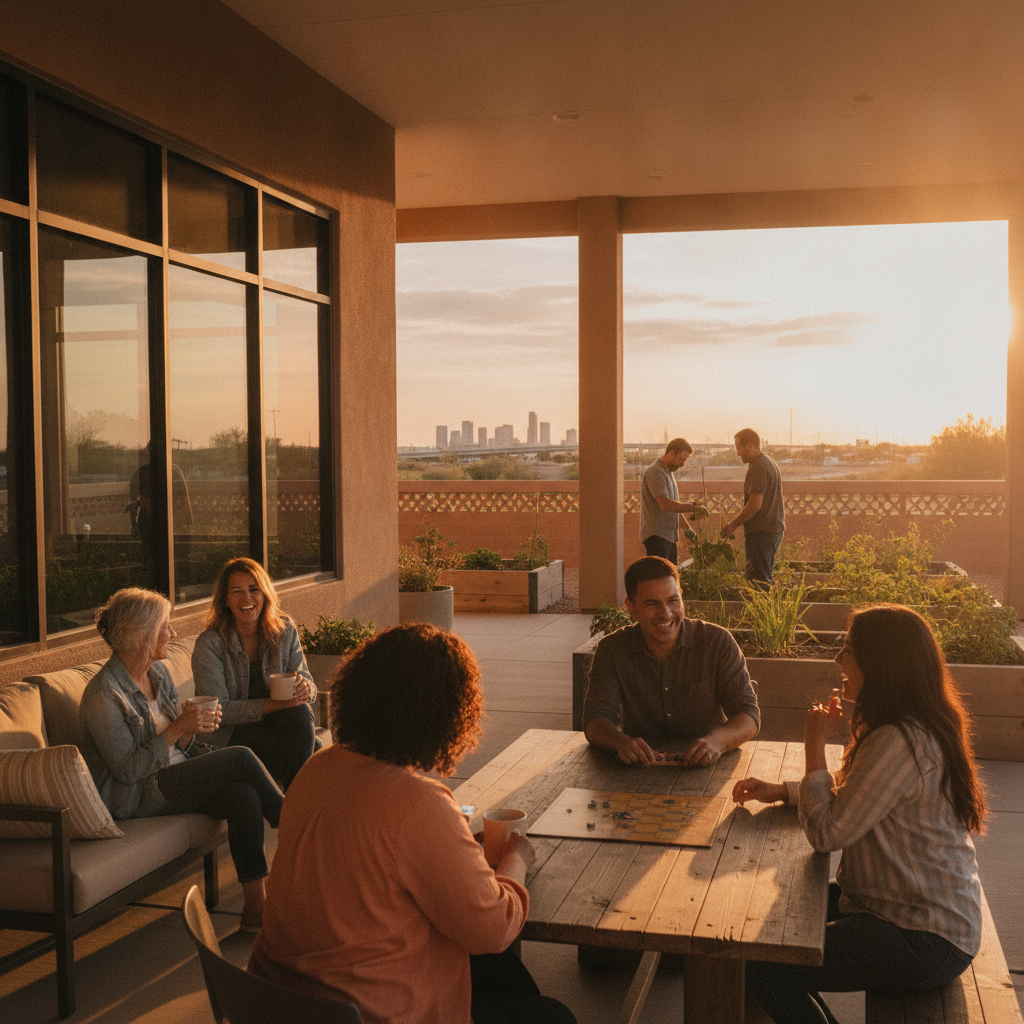
One of the most powerful and least-discussed aspects of residential care is peer connection — the relationships that form between residents who are going through similar experiences at the same time. For many adults in treatment, this is the first time they have ever met someone else who truly understands what it is like to live with their diagnosis.
That recognition — I am not the only one, and I am not broken in a way no one else has ever been — can shift something fundamental in how a person sees themselves and their future. It is not therapy, exactly. But it is therapeutic in a way that no one-on-one session with a clinician can fully replicate.
Families in Glendale, Mesa, Laveen, and across South Phoenix sometimes worry that putting their loved one in a group setting will be frightening or destabilizing. In a well-run BHRF, the opposite is usually true. The structure, clinical oversight, and shared experience of residential living tend to make peer connection feel safer than it does in the unpredictable outside world.
Building Social Skills That Outlast the Program
Reconnecting during treatment is meaningful. But what matters most for long-term recovery is whether the skills built inside a residential program transfer to real life after discharge. This is where independent living skills training becomes essential — and where many programs fall short.
Independent living skills training is not just about budgeting or taking medications on schedule. It includes the social and interpersonal skills that chronic mental illness can erode over time: how to initiate and maintain conversations, how to navigate conflict without shutting down or escalating, how to ask for help, how to participate in a community — a neighborhood, a faith community, a clinic waiting room, a bus stop — without feeling overwhelmed.
For adults in Peoria, Chandler, and across Maricopa County who are preparing to return to independent or supported living after a residential stay, these skills are often the difference between a stable transition and a rapid return to isolation and crisis. The goal is not just symptom management. It is a life that has real relationships in it.
How AHCCCS Coverage Applies to This Level of Care
Many families in the Phoenix area do not pursue residential mental health treatment because they assume it is unaffordable. In fact, Arizona Health Care Cost Containment System — AHCCCS, which is Arizona’s Medicaid program — covers licensed BHRF treatment for qualifying adults, including the group therapy, skills training, medication management, and crisis stabilization that form the core of residential care.
If your loved one is enrolled in AHCCCS, or if you are not sure whether they qualify, the admissions team at Bougainvillea Manor can help you verify coverage before you make any decisions. Commercial insurance is also accepted. The financial piece should not be what stops a family from making the call.
A Note for Case Managers and Discharge Planners
If you are a case manager, discharge planner, or a member of an ART (Adult Recovery Team) or CFT (Child and Family Team) referring a client who has experienced significant social withdrawal alongside their primary diagnosis, please know that this is something we take seriously in treatment planning from day one. Isolation is not a secondary concern — it is often a primary driver of relapse and rehospitalization, and our programming reflects that. We coordinate directly with referring providers to ensure continuity, and we work with RBHA — Regional Behavioral Health Authority — partners across Maricopa County to facilitate smooth authorization and admission when beds are available.
Frequently Asked Questions
Can someone who is severely socially withdrawn actually participate in group therapy right away?
Not always — and that is expected. A good residential program meets residents where they are. Clinicians assess each person’s comfort level and gradually increase social engagement as stabilization occurs. No one is forced into group participation before they are ready.
My loved one in South Phoenix has been isolated for over a year. Is it too late for residential treatment to help?
It is not too late. Longer periods of isolation often mean that more intensive, structured support is needed — which is exactly what residential care provides. Early intervention is always better, but people do recover meaningful social connection even after extended withdrawal.
Does AHCCCS cover group therapy and peer support as part of a residential stay?
Yes. When group therapy and peer-based services are provided within a licensed BHRF, they are part of the covered residential level of care under AHCCCS — not billed separately. This is one reason why residential care can actually be more cost-effective than piecemeal outpatient services for people with higher-level needs.
How is loneliness addressed in the discharge plan after residential treatment ends?
Discharge planning at a quality BHRF should include concrete connections to community-based supports — outpatient therapy, peer support programs, AHCCCS-funded behavioral health services, and in some cases supported housing — so that the person does not return to isolation the day they leave. This is part of what makes the difference between a revolving-door experience and a stable transition.
What if my family member refuses to go to treatment because they have stopped trusting people?
This is one of the most common and most painful situations families face. A clinical team experienced in working with trauma and isolation can often help bridge that gap — sometimes through a warm, low-pressure conversation before admission rather than a formal intake process. If you are not sure where to start, reaching out to ask questions costs nothing and commits no one to anything.
You Do Not Have to Wait for a Crisis to Make the Call
If someone you love has been pulling away from the world — and you sense that what they are carrying is more than therapy appointments and prescription refills can reach — please do not wait until they are in crisis to explore residential care. The families who reach out early, before things escalate, almost always tell us they wish they had called sooner.
Bougainvillea Manor Behavioral Health is a licensed BHRF located in Phoenix, serving adults across Maricopa County including Glendale, Peoria, Chandler, Mesa, Laveen, and South Phoenix. We accept AHCCCS, Medicaid, and most commercial insurance plans. Our admissions team can answer your questions, verify insurance coverage, and help you understand what the next step looks like — without pressure and without judgment.
Contact us today to speak with someone who can help you figure out whether residential treatment is the right fit — and what it would take to get there.