What Does ‘Sober Living’ Actually Mean in Phoenix — and How Is It Different From a Licensed Residential Mental Health Facility?
If you’ve spent any time searching for residential mental health care in Phoenix, you’ve probably noticed that the results look remarkably similar — group homes, residential programs, structured living environments. Some are licensed. Some are not. And the marketing language rarely makes the difference easy to spot. If your loved one is in crisis and you’re trying to find the right level of care quickly, that confusion can cost precious time — or worse, land them somewhere that simply isn’t equipped to help.
The short answer is this: sober living homes and licensed Behavioral Health Residential Facilities (BHRFs) are not the same thing, and they are not interchangeable. Understanding the difference isn’t just a technicality — it directly affects whether your loved one will receive clinical treatment, whether their AHCCCS (Arizona Health Care Cost Containment System, Arizona’s Medicaid program) coverage will apply, and whether staff on-site are qualified to respond if their condition gets worse.
What Is a Sober Living Home?
A sober living home is a shared residential setting designed to support people in early recovery from substance use — typically after they’ve already completed a formal treatment program. These homes provide structure, peer accountability, and a substance-free living environment. They are not required to be licensed by the Arizona Department of Health Services (ADHS). In most cases, they do not employ licensed clinical staff. They do not provide therapy, psychiatric oversight, medication management, or individualized treatment planning.
That’s not a criticism — for someone who has completed treatment and needs a bridge back to independent living, a well-run sober living home can be genuinely useful. But it is a supervised housing arrangement, not a treatment program. And in the Phoenix metro area, including communities like Glendale, Avondale, and West Phoenix, there is a real and well-documented problem with unlicensed facilities marketing themselves in ways that blur this distinction — sometimes deliberately.
What Is a Licensed BHRF — and Why Does Licensure Matter?
A Behavioral Health Residential Facility, or BHRF, is a licensed residential treatment program regulated by ADHS and required to meet Arizona’s Administrative Code standards for behavioral health services — including compliance with AHCCCS AMPM Policy 320-V, which governs residential behavioral health services for AHCCCS members. A licensed BHRF is a clinical treatment setting, not just a place to live.
Here’s what that means in practice:
- Licensed clinical staff — including licensed professional counselors, social workers, and psychiatric professionals — must be present and accountable for each resident’s care.
- Every resident receives an individualized treatment plan based on a clinical assessment of their specific needs.
- Psychiatric services and medication management are integrated into the program, not left to the resident to coordinate on their own.
- The facility is subject to regular ADHS inspections and must meet specific staffing, safety, and documentation requirements.
- AHCCCS and Regional Behavioral Health Authority (RBHA) funding — the managed care organizations that administer Medicaid behavioral health benefits in Maricopa County — can only be billed for services provided at a licensed, ADHS-certified facility.
That last point is critical for families navigating AHCCCS coverage. If your loved one is enrolled in AHCCCS and you place them in an unlicensed facility, there is no Medicaid coverage for that stay. The costs fall entirely out-of-pocket, and there is no clinical accountability structure protecting your loved one during their time there.
The Overlap Problem: When Substance Use and Mental Health Are Both in the Picture
Here’s where the confusion becomes especially dangerous. Many adults in Phoenix who need residential mental health care also have a history of substance use — what clinicians call a co-occurring or dual diagnosis presentation. Depression with alcohol dependence. Bipolar disorder with cannabis use. PTSD with opioid misuse. These situations are common, and they require integrated treatment that addresses both conditions simultaneously.
A sober living home is not designed to treat mental illness. A facility that only addresses substance use without also treating the underlying psychiatric condition is likely to see the same person return to crisis. Dual diagnosis treatment at a licensed BHRF means a psychiatrist and clinical team are working together to address both sides of the picture at the same time — adjusting medications, running evidence-based therapy groups, and building a discharge plan that accounts for both recovery and mental health stability.
If a family in Tempe or Mesa is searching for help for a loved one with severe depression and a drinking problem, being placed in a sober living home may feel like progress in the moment. But without psychiatric care and structured mental health treatment, the underlying illness continues untreated.
Questions That Help You Tell the Difference
When you’re calling facilities in a hurry — which is how most families approach this — it can be hard to know what to ask. Here are a few questions that will quickly clarify whether you’re talking to a licensed clinical program or a supervised housing arrangement:
- “Are you licensed by ADHS as a Behavioral Health Residential Facility?” A licensed BHRF will answer yes without hesitation and can provide their license number.
- “Do you have a psychiatrist or prescriber on staff?” If the answer involves phrases like “we refer out” or “residents handle their own medications,” that’s a sober living model, not a clinical treatment model.
- “Do you accept AHCCCS?” Only licensed, ADHS-certified facilities can receive AHCCCS reimbursement. If they don’t accept AHCCCS, ask why — the answer is often revealing.
- “What does a typical treatment day look like?” A licensed BHRF will describe structured clinical programming — groups, individual therapy, psychiatric check-ins. A sober living home will describe house rules, chores, and curfews.
- “What happens if my family member has a psychiatric crisis overnight?” A licensed BHRF has 24-hour trained staff with clinical protocols. This is a non-negotiable safety question.
What Bougainvillea Manor Provides — and What Sets a Licensed BHRF Apart
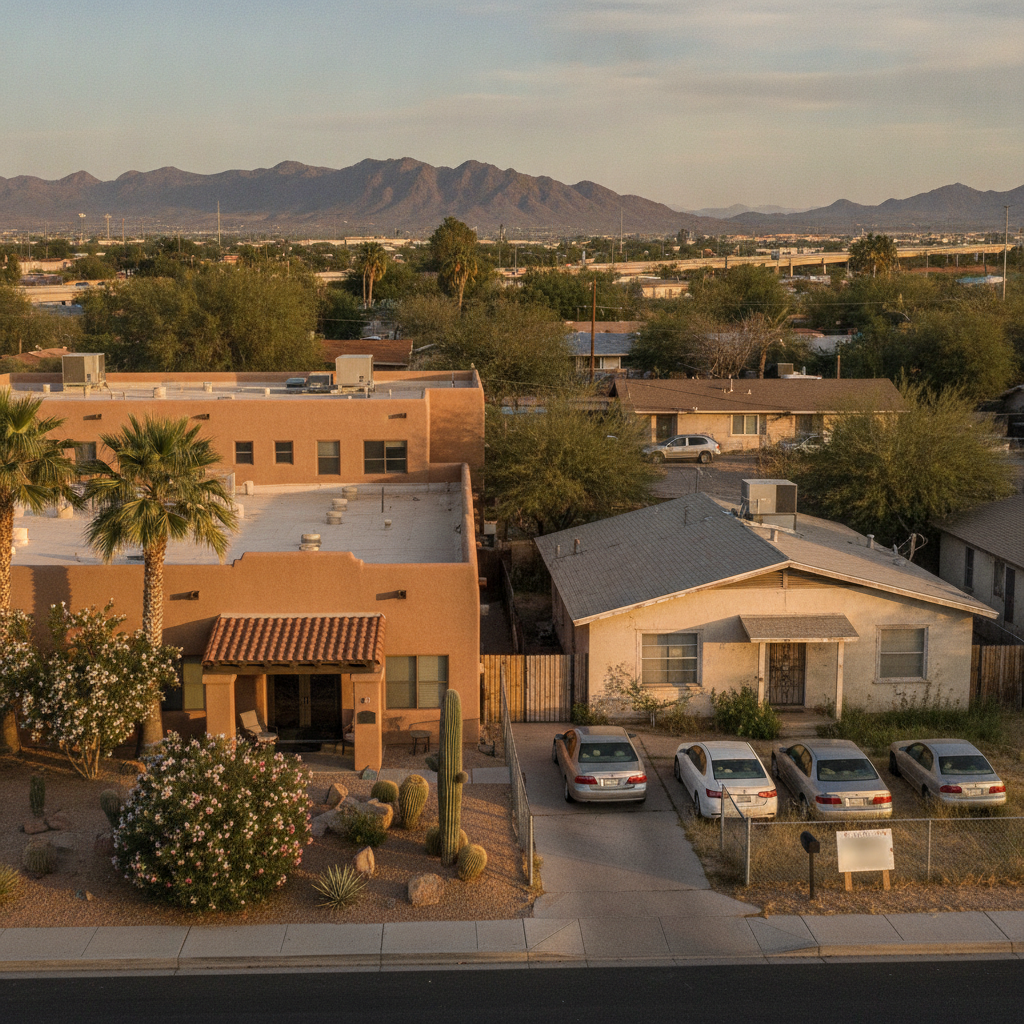
Bougainvillea Manor Behavioral Health is a licensed BHRF located in Phoenix, serving adults across Maricopa County — including residents from Glendale, Avondale, Mesa, Tempe, and communities throughout the region. We provide 24-hour structured residential mental health and dual diagnosis treatment in a clinical setting with licensed staff, psychiatric oversight, and individualized treatment planning.
Our program includes mental health treatment for conditions like depression, bipolar disorder, PTSD, anxiety disorders, schizophrenia, schizoaffective disorder, and personality disorders — as well as integrated dual diagnosis care for adults managing co-occurring substance use. We also offer independent living skills training to help residents build the practical skills they need to sustain stability after discharge.
We accept AHCCCS and work directly with RBHAs, Adult Recovery Teams (ARTs), Child and Family Teams (CFTs), hospital discharge planners, and case managers to coordinate authorizations and streamline admissions. Bed availability in licensed BHRFs across Maricopa County is genuinely limited relative to need — if you’re trying to place someone urgently, reaching out early in the day gives families the best chance of securing a placement quickly.
Frequently Asked Questions
Can a sober living home treat depression or bipolar disorder?
No. Sober living homes are housing arrangements, not clinical treatment programs. They do not employ licensed psychiatric or clinical staff, and they are not authorized to provide mental health treatment. If your loved one has a diagnosed mental health condition, they need a licensed BHRF with clinical programming — not supervised housing.
Will AHCCCS pay for sober living?
AHCCCS (Arizona’s Medicaid program) does not cover the cost of staying in an unlicensed sober living home. AHCCCS residential behavioral health benefits apply only to services delivered in licensed, ADHS-certified facilities that meet the state’s AMPM 320-V standards. If cost is a concern, the first step is confirming licensure.
How do I verify that a facility in Phoenix is actually licensed?
You can ask the facility directly for their ADHS license number, or search the Arizona Department of Health Services behavioral health licensing database. A legitimate licensed BHRF will have no hesitation providing this information. You can also call your RBHA — the managed care organization administering your loved one’s AHCCCS behavioral health benefits — to confirm whether a specific facility is in-network.
My loved one in West Phoenix needs both mental health and substance use treatment. Which type of facility is right?
A licensed BHRF with an integrated dual diagnosis program is the appropriate level of care. This means both the mental health condition and the substance use disorder are treated simultaneously by a coordinated clinical team — not sequentially, and not in separate facilities. Treating one without the other significantly increases the risk of relapse and re-hospitalization.
What if a facility says it’s a “residential program” but won’t confirm ADHS licensure?
That is a significant red flag. In Arizona, any facility holding itself out as a residential behavioral health treatment program is required to be licensed by ADHS. If a facility is evasive about its licensure status, do not place a loved one there. Contact your RBHA or a licensed facility directly for help identifying appropriate, vetted options.
Ready to Talk to a Licensed Residential Mental Health Program in Phoenix?
If you’re trying to sort out the right level of care for someone you love — or if you’re a case manager, discharge planner, or RBHA care coordinator looking for a licensed placement in Maricopa County — we’re here to help you navigate this. Bougainvillea Manor Behavioral Health is a licensed BHRF in Phoenix with experienced clinical staff, AHCCCS authorization support, and genuine capacity to treat complex mental health and dual diagnosis presentations.
You don’t have to figure this out alone, and you don’t have to settle for a placement that isn’t built to actually treat what your loved one is going through. Reach out to our admissions team today — we’ll answer your questions honestly, explain what we can offer, and help you understand whether our program is the right fit.