How Does Residential Mental Health Treatment Actually Work Day to Day in Phoenix?
If you’re trying to help someone you love get into residential mental health treatment in Phoenix — or you’re researching it for yourself — one of the most common questions never seems to get a straight answer: What actually happens inside one of these programs? What does a person do all day? Is it like a hospital? Is it a locked unit? Will there be time to rest, or will it feel overwhelming? These are fair, important questions, and the fact that most treatment facility websites don’t answer them clearly is a real problem. This article is here to change that.
What Is a Licensed BHRF, and Why Does the Structure Matter?
A BHRF — behavioral health residential facility — is a licensed, 24-hour residential care setting for adults experiencing significant mental health challenges. In Arizona, BHRFs are licensed by the Arizona Department of Health Services (ADHS) and must meet specific clinical and safety standards to operate legally. This is different from a sober living home, a group home without clinical staff, or a crisis stabilization unit. A licensed BHRF provides structured, therapeutic programming throughout the day — not just a safe place to sleep.
That structure is actually the point. For many adults in Phoenix and across Maricopa County, daily life before residential treatment has become chaotic — missed medications, disrupted sleep, social isolation, or repeated crisis episodes. The daily rhythm of a licensed program is one of the most stabilizing things it offers, often before any single therapy session produces a visible breakthrough.
A Typical Day in Residential Mental Health Treatment
Every licensed BHRF runs its programming a little differently, but most follow a structured daily schedule that balances clinical care, skills development, personal time, and rest. Here’s a general picture of what that can look like.
Morning: Routine, Medication, and the First Group of the Day
The day typically begins with a consistent wake time — something many residents haven’t experienced in months. Morning routines include personal hygiene, breakfast, and morning medication administration overseen by clinical staff. Medication management is a core component of residential care: a psychiatrist or psychiatric nurse practitioner reviews each resident’s medications regularly, tracks how they’re responding, and makes adjustments as needed. This kind of close, continuous oversight is simply not possible in an outpatient setting where you see a prescriber once a month.
After breakfast, most programs begin the morning with a community check-in or morning group — a low-pressure opportunity for residents to share how they’re feeling, set an intention for the day, and hear from peers who are going through similar experiences. For someone who has felt completely alone in their struggle, these moments of genuine connection often matter more than they expected.
Late Morning and Afternoon: Therapy, Skills, and Individual Work
The heart of the clinical day happens in late morning and afternoon. This typically includes a mix of structured group therapy sessions — which might focus on coping skills, emotional regulation, cognitive patterns, or trauma processing — and individual sessions with an assigned clinician. The therapeutic approaches used depend on a resident’s specific diagnosis and treatment plan. Adults dealing with depression, anxiety, bipolar disorder, PTSD, or psychotic disorders like schizophrenia each have different clinical needs, and a quality program tailors the work accordingly.
Many programs also weave in independent living skills training during afternoon programming. These sessions address practical life skills — managing medications independently, budgeting, maintaining hygiene routines, navigating community resources — that are essential for a successful transition after discharge. For adults who have been hospitalized multiple times or have struggled to maintain stability in the community, these skills aren’t trivial. They’re foundational. Learn more about independent living skills training at Bougainvillea Manor.
Evening: Wind-Down, Peer Support, and Rest
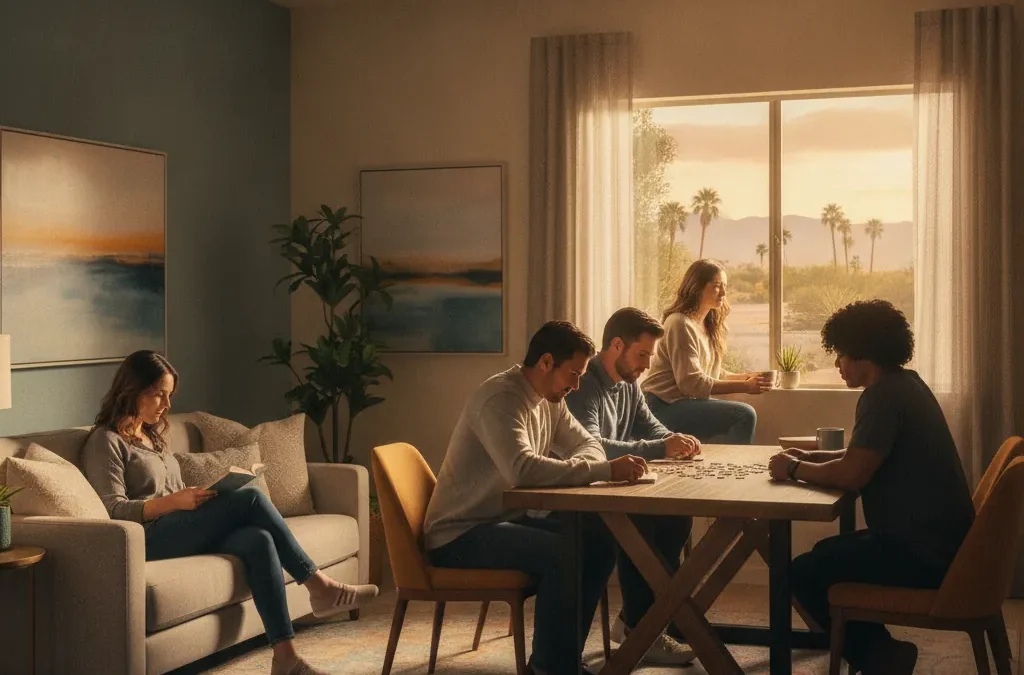
Evenings in a residential program are generally quieter. There may be a light evening group — sometimes focused on reflection, gratitude, or peer support — followed by dinner, free time, and a structured wind-down routine that supports better sleep. Staff are present around the clock, which means if a resident is struggling at 2 a.m., someone is there. That 24-hour presence is one of the defining differences between residential and any form of outpatient care.
The Piece Most Facility Websites Don’t Talk About: What Stabilization Actually Looks Like
Here’s a gap that most competitor sites in the Phoenix area leave wide open: they list services and post stock photos, but they rarely explain what stabilization actually means in practice — and why it takes time.
When someone first arrives at a residential program, especially after a psychiatric hospitalization or a period of acute crisis, they are not ready for intensive therapy. Their nervous system is dysregulated. Their medications may need adjustment. They may not have slept properly in days. The first phase of residential care — often the first week or two — is less about breakthrough insights and more about restoring basic biological and psychological safety: consistent sleep, consistent meals, consistent human contact, and the right medications at the right doses.
Families sometimes worry when a loved one isn’t immediately reporting feeling better. This is normal. Stabilization is the precondition for everything else that follows. Without it, therapy doesn’t land the way it should. Understanding this helps families set realistic expectations and support the process rather than second-guess it.
How AHCCCS Coverage Fits Into the Daily Reality
For many residents in Phoenix, South Phoenix, Laveen, Glendale, and across Maricopa County, AHCCCS — Arizona’s Medicaid program, the Arizona Health Care Cost Containment System — covers the cost of residential treatment at a licensed BHRF. This is significant, because residential mental health treatment is not inexpensive, and for families without commercial insurance, AHCCCS coverage can make the difference between accessing care and not accessing it at all.
What families should know is that AHCCCS-covered residential care still requires authorization through the relevant RBHA — Regional Behavioral Health Authority — or through a referral from an Adult Recovery Team (ART) or Child and Family Team (CFT). These are the coordinating bodies within the Maricopa County behavioral health system that manage access to higher levels of care. Admissions through these pathways are common and well-established; a good residential facility will have existing relationships with these teams and can guide families through the process. See what insurance Bougainvillea Manor accepts.
What to Ask When You’re Comparing Residential Programs in the Phoenix Area
Not all licensed BHRFs offer the same depth of programming. When you’re evaluating options in Phoenix, Tempe, Mesa, or the surrounding area, here are questions worth asking directly:
- How many hours of structured clinical programming are offered each day?
- Is there a psychiatrist or psychiatric nurse practitioner on-site or on-call for medication management?
- Does the program offer individualized treatment plans, or is everyone in the same groups?
- What happens at discharge — is there a transition plan, and does the team coordinate with outpatient providers?
- Is the facility ADHS-licensed, and does it accept AHCCCS?
- What is the staff-to-resident ratio during daytime and overnight hours?
A facility that can answer these questions clearly and without hesitation is one that takes its clinical standards seriously.
Frequently Asked Questions
Is residential mental health treatment the same as being in a hospital?
No. A licensed BHRF is not a hospital or a locked psychiatric unit. It’s a community-based, residential setting where adults live and receive structured therapeutic care. Residents are not involuntarily held — they’re there voluntarily and are supported in building skills and stability in a home-like environment.
How long does a typical stay in residential treatment last in Phoenix?
Length of stay varies based on clinical need, diagnosis, and the individual’s progress. Many adults stay anywhere from two weeks to several months. For AHCCCS-covered residents, length of stay is typically subject to ongoing authorization review by the RBHA, meaning the clinical team regularly documents continued medical necessity.
Can families visit or communicate with their loved one during treatment?
Most residential programs in the Phoenix area do allow family contact, though there may be structured guidelines around visitation, especially in the early days of a stay. Ask the specific facility about their family engagement policies — some even offer family therapy sessions as part of the program.
What happens after residential treatment ends?
Discharge planning is built into residential care from the beginning. A good program coordinates with outpatient providers, case managers, ARTs, and community supports before a resident leaves. The goal is to ensure continuity — so the stability gained in residential care doesn’t dissolve in the first week back in the community.
Does Bougainvillea Manor accept AHCCCS for residential mental health treatment?
Yes. Bougainvillea Manor Behavioral Health is a licensed BHRF in Phoenix that accepts AHCCCS/Medicaid as well as many commercial insurance plans. The admissions team can help verify coverage and coordinate with referring teams including ARTs, CFTs, and hospital discharge planners across Maricopa County.
Ready to Learn More or Start the Admissions Process?
If you’re a family member trying to understand whether residential treatment is the right next step, or a case manager looking for a licensed BHRF in the Phoenix area with capacity and clinical depth, Bougainvillea Manor Behavioral Health is here to help. We serve adults across Phoenix, South Phoenix, Laveen, Glendale, Tempe, Mesa, and surrounding communities — and we work with AHCCCS, RBHA referrals, and commercial insurance. Contact us today to speak with an admissions team member, ask questions, or begin the intake process. You don’t have to figure this out alone.