What Is AHCCCS and Does It Cover Residential Mental Health Treatment in Phoenix?
If someone you love is struggling and you’ve been told they need a higher level of care — something beyond weekly therapy or an emergency room visit — the first question most families ask is: how do we pay for this? In Phoenix and across Maricopa County, many adults qualify for AHCCCS (pronounced “access”), Arizona’s Medicaid program, and AHCCCS can cover the full cost of licensed residential mental health treatment. But understanding how it works, who qualifies, and what steps to take is rarely explained clearly anywhere. This guide is here to change that.
What Is AHCCCS?
AHCCCS stands for the Arizona Health Care Cost Containment System. It is Arizona’s version of Medicaid — a joint federal and state health insurance program for people who meet certain income and residency requirements. If you qualify, AHCCCS covers medical care, behavioral health services, prescription medications, and — critically — residential mental health treatment at licensed facilities.
AHCCCS is not a charity program or a last resort. It is a health insurance benefit that hundreds of thousands of Arizona adults use every year, including many people across Phoenix, Laveen, Maryvale, West Phoenix, South Phoenix, and neighboring communities who have worked their whole lives and simply don’t have employer-sponsored coverage.
Does AHCCCS Actually Cover Residential Mental Health Treatment?
Yes — when the treatment is delivered at a facility that meets Arizona’s standards. For residential mental health care, that means a licensed Behavioral Health Residential Facility, or BHRF. A BHRF is a specific license category issued by the Arizona Department of Health Services (ADHS). It is not the same as a sober living home, a group home, or an unlicensed supportive housing arrangement. A licensed BHRF provides 24-hour structured care with clinical oversight, psychiatric services, medication management, and individualized treatment — and it must comply with AHCCCS AMPM Policy 320-V, which governs how residential behavioral health services are delivered and billed under Medicaid.
When a facility holds the proper licensure and is enrolled as an AHCCCS provider, AHCCCS can cover residential mental health treatment at no cost to the member, or with very minimal cost sharing. This includes treatment for conditions like depression, bipolar disorder, PTSD, schizophrenia, schizoaffective disorder, anxiety disorders, and co-occurring substance use disorders.
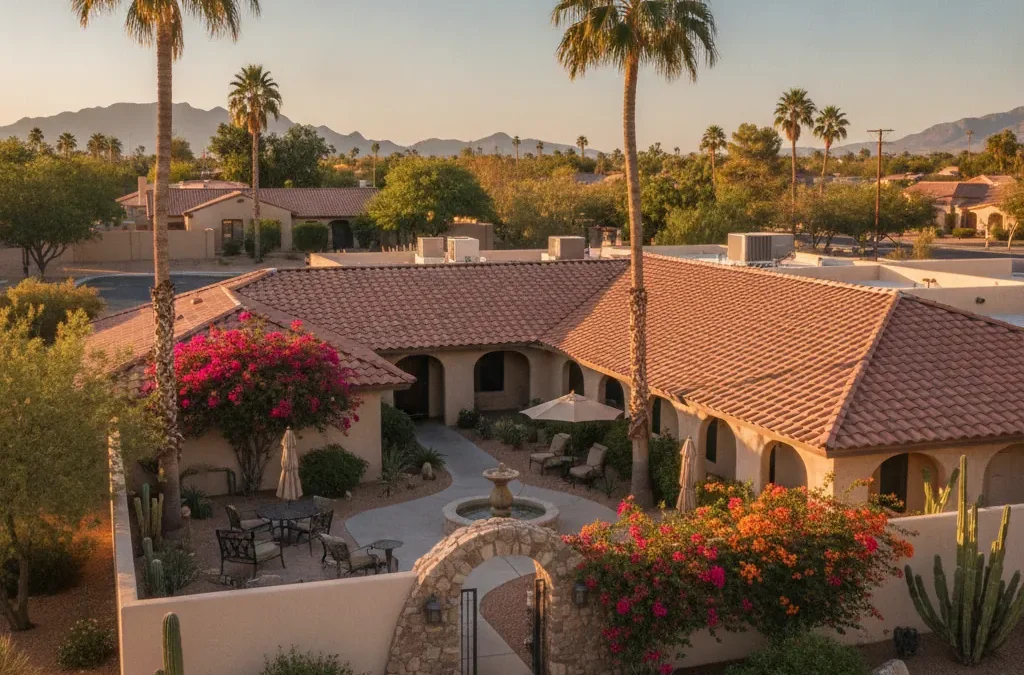
At Bougainvillea Manor Behavioral Health, we are a licensed BHRF in Phoenix that accepts AHCCCS and works with Maricopa County’s Regional Behavioral Health Authority (RBHA) network. You can learn more about our behavioral health residential treatment program to understand the level of care we provide.
Who Qualifies for AHCCCS in Arizona?
Eligibility is based primarily on income and Arizona residency. Most adults who earn at or below 138% of the federal poverty level qualify. You do not need to be permanently disabled to qualify. Many working adults, caregivers, and people between jobs meet the income threshold. You also do not need to have children in the household — single adults can qualify under the AHCCCS Complete Care program, which covers behavioral health services.
You do need to be an Arizona resident and a U.S. citizen or qualifying immigrant. Age matters for some sub-programs, but most adults aged 19 to 64 are eligible under the standard expansion.
If you are not sure whether you or your loved one qualifies, the fastest route is to apply through the Health-e-Arizona Plus portal online or call the AHCCCS enrollment line. In urgent situations — especially when someone has just been discharged from a hospital or is in acute crisis — enrollment can sometimes be expedited.
How Does AHCCCS Authorize Residential Treatment? What Is a Prior Authorization?
This is the part that confuses most families, and it is worth taking a moment to explain clearly. AHCCCS does not directly manage your day-to-day behavioral health care in Maricopa County. Instead, it contracts with a Regional Behavioral Health Authority (RBHA) — a managed care organization that coordinates behavioral health services for AHCCCS members in the county. The RBHA reviews whether residential treatment is clinically necessary and issues what’s called a prior authorization, or prior auth, before the stay is covered.
A prior authorization is essentially the RBHA’s approval that the level of care is medically necessary for that person at that time. Licensed facilities like Bougainvillea Manor handle the prior authorization process on your behalf — you do not have to navigate it alone. Our intake team works directly with the RBHA to submit clinical documentation, request authorization, and coordinate the transition into care as quickly as possible.
Families in South Phoenix, Avondale, Glendale, Peoria, and Mesa are often surprised to learn that the authorization process — while real — does not have to take weeks. In many urgent situations, expedited authorization can happen within 24 to 72 hours when the clinical need is clearly documented.
What If My Loved One Doesn’t Have AHCCCS Yet?
This is one of the most common situations families face. Someone is in crisis, they need care now, and they don’t have active insurance coverage. If there is a reasonable expectation that they qualify for AHCCCS, our admissions team can help guide you on next steps. In some circumstances, AHCCCS coverage can be applied retroactively to cover care that began during the application period. Every situation is different, and the specifics matter — which is why it helps to speak with someone who works with AHCCCS every day rather than trying to piece it together from a state website.
We also accept certain commercial insurance plans. You can verify your insurance coverage through our website, or simply call us and our team will check benefits with you directly.
A Note on the Difference Between AHCCCS-Covered BHRFs and Unlicensed Housing
In the Phoenix metro — particularly along the Interstate 10 corridor and in communities like Maryvale, West Phoenix, and Laveen — there is no shortage of group homes, sober living houses, and informal supportive housing arrangements. Some of these serve real purposes. But none of them are licensed BHRFs, and none of them are covered by AHCCCS for residential mental health treatment. The distinction matters enormously when someone is in a serious mental health crisis or managing a complex co-occurring condition. Unlicensed settings do not provide psychiatric oversight, medication management, individualized clinical care, or 24-hour structured programming.
If AHCCCS is paying for care, that care must occur in a properly licensed and enrolled facility. It’s one of the most important questions families can ask before accepting a placement offer anywhere.
Frequently Asked Questions
Does AHCCCS cover the full cost of residential mental health treatment, or is there a copay?
For most AHCCCS members, residential mental health treatment at a licensed BHRF is covered with little to no cost sharing. Some plans may have a nominal copay, but cost should not be a barrier to accessing care. Our admissions team can clarify what your specific AHCCCS plan covers before you commit to anything.
Can I choose which residential facility my loved one goes to, even with AHCCCS?
You generally have some choice, but the facility must be a licensed, AHCCCS-enrolled BHRF in the RBHA network. Not all residential programs in Phoenix are enrolled AHCCCS providers, so it’s important to confirm this before assuming coverage applies. Bougainvillea Manor is an enrolled AHCCCS provider in Maricopa County.
How long will AHCCCS cover a residential mental health stay?
There is no fixed number of days. Coverage is based on medical necessity — meaning it continues as long as the RBHA agrees the level of care is clinically appropriate. Authorization is typically reviewed at regular intervals. A well-documented treatment plan and consistent communication between the facility and the RBHA keeps the process moving smoothly.
What if my family member’s AHCCCS lapsed or was terminated?
Lapsed coverage is common, especially during periods of housing instability or crisis. Reinstatement may be possible, and in some situations a retroactive eligibility determination can cover a gap period. The best step is to contact our admissions team — we can help you understand the options and avoid delays in getting care started.
Can a case manager, discharge planner, or ART worker refer directly to Bougainvillea Manor for an AHCCCS-covered admission?
Yes. We work regularly with case managers, hospital discharge planners, Adult Recovery Teams (ARTs), and Child and Family Teams (CFTs) throughout Maricopa County. If you are a behavioral health professional coordinating a placement, please contact us directly. We can discuss clinical fit, current availability, and the authorization process for your specific client’s situation.
You Don’t Have to Figure This Out Alone
The AHCCCS system can feel overwhelming when you’re already managing a crisis. Between eligibility questions, the RBHA authorization process, and the challenge of finding a licensed BHRF with available beds in the Phoenix area, it’s easy to feel like every path forward is blocked. It isn’t. Our team at Bougainvillea Manor Behavioral Health has guided many families through this exact moment — from Laveen and Mesa to Glendale and Peoria — and we know how to move quickly when time matters.
If you’re ready to find out whether AHCCCS will cover residential treatment for your loved one, or if you have questions about what care at our facility looks like, please reach out to our admissions team today. We offer confidential consultations, and we’ll give you honest answers — not a sales pitch.