How Does a Family in Laveen or South Phoenix Talk to Someone About Going to Residential Mental Health Treatment When Stigma Is the Biggest Barrier?
If someone you love is struggling with their mental health — and you already know in your gut that they need more support than weekly therapy or a medication refill can offer — one of the hardest things you may face isn’t finding a facility. It’s having the conversation. In communities like Laveen, South Phoenix, and Maryvale, that conversation is often made even harder by deep cultural, generational, or family beliefs about what it means to seek mental health care. This guide is for you. We’re going to walk through the stigma that gets in the way, how to actually start that conversation, and what residential mental health treatment in Phoenix really looks like — because the fear of the unknown is often worse than the reality.
Why Stigma Hits Harder in Some Communities — And Why That Makes Sense
Stigma around mental illness is not unique to any one neighborhood or family. But it tends to run deeper in communities where mental health care has historically been inaccessible, misunderstood, or associated with punishment rather than healing. Families in South Phoenix and Laveen often describe feeling like residential treatment is something that happens to other people — or something that signals failure, weakness, or loss of control over a family member.
Those feelings are understandable. They didn’t come from nowhere. And they’re worth naming honestly before you ever sit down to talk with your loved one, because if you’re carrying shame into that conversation, they’ll feel it — and they’ll pull away. The most important thing you can do before you say a word is get clear on something yourself: seeking residential mental health treatment is not giving up on someone. It is the opposite of giving up. It is choosing, deliberately and courageously, to get them the level of care they actually need.
What Residential Treatment Actually Is — Without the Scary Framing
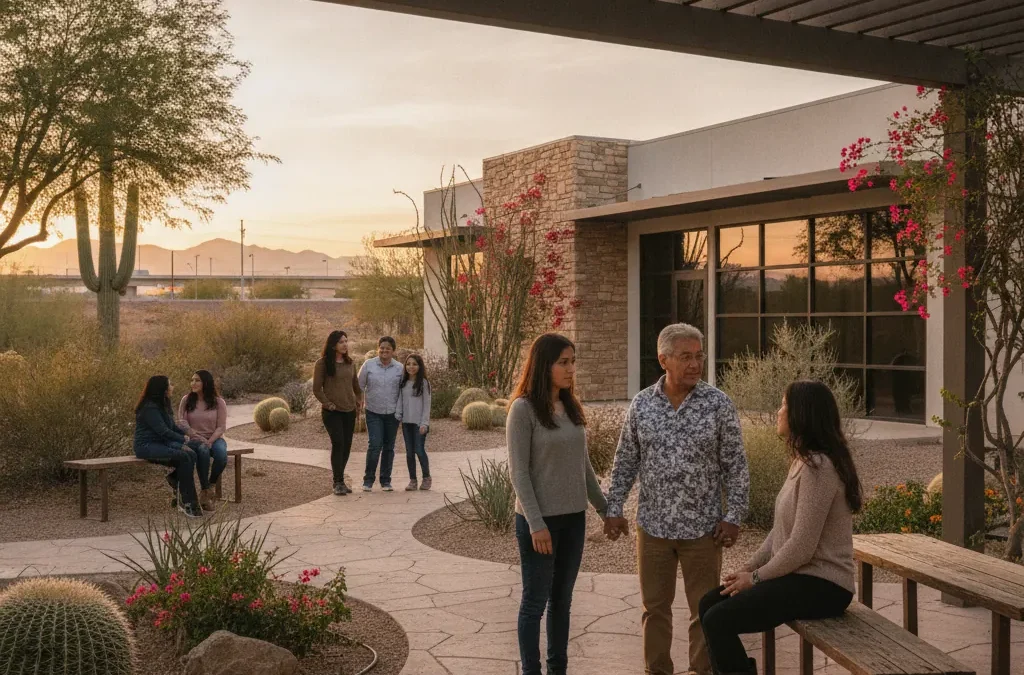
Many families picture something institutional, isolating, or punitive when they hear “residential treatment.” That fear is one of the biggest reasons people wait too long. A licensed Behavioral Health Residential Facility (BHRF) — which is what Bougainvillea Manor is — is a community-based, home-like setting where adults live on-site and receive structured mental health care around the clock. It’s not a locked psychiatric ward. It’s not a hospital. It is a safe, staffed environment where your loved one can stabilize, sleep, receive medication support, work with therapists, and begin rebuilding daily skills — all without the chaos of the outside world interrupting the process.
Licensed BHRFs in Arizona are regulated by the Arizona Department of Health Services (ADHS) and, for AHCCCS members, must meet specific clinical standards under the state’s Behavioral Health Residential Treatment guidelines. The level of care is serious and professional — but the environment is designed to feel like a home, not an institution.
How to Actually Start the Conversation — A Practical Approach
There is no perfect script. But there are approaches that tend to open doors rather than close them.
Choose the Right Moment — Not a Crisis
If possible, don’t try to have this conversation in the middle of a breakdown, an argument, or a high-emotion moment. Choose a calm, private time when your loved one feels relatively safe and is not in immediate crisis. If they are in active crisis right now, call a crisis line or a facility directly — that’s a different situation that calls for a different response, not a conversation.
Lead With Love, Not Diagnosis
You don’t need to diagnose your loved one or list everything they’ve done wrong. Try opening with what you’ve observed from a place of care: “I’ve noticed you’ve been really struggling lately, and I’m scared for you. I love you and I want you to get real support.” That’s it. You’re not trying to win a debate. You’re trying to open a door.
Address the Fear of What “Going Away” Means
Many people resist residential treatment because they’re afraid of what it means — losing their freedom, being seen differently by family, not being able to leave. Be honest about what residential treatment actually looks like: a structured, supportive environment, not a prison. Let them ask questions. And if you don’t know the answer to something, say so — and offer to find out together.
Take the Insurance Question Off the Table
Cost and insurance are real worries, especially for families navigating the Maricopa County behavioral health system. AHCCCS (Arizona Health Care Cost Containment System) — Arizona’s Medicaid program — covers residential mental health treatment for eligible adults at licensed facilities like Bougainvillea Manor. If your loved one has AHCCCS, that coverage can remove one of the biggest practical barriers. You can verify insurance coverage quickly and confidentially before any decisions are made, so that fear doesn’t have to be part of the conversation at all.
When Your Loved One Pushes Back — What to Do Next
Not every first conversation ends with a yes. That’s okay. Your goal the first time isn’t necessarily to get agreement — it’s to plant a seed and keep the relationship intact. If your loved one pushes back hard, don’t force it. Let them know you’re not going anywhere and that you’ll bring it up again. Document what you’re seeing. Talk to a case manager, social worker, or your loved one’s existing treatment provider about your concerns. If your family has a connection with an Adult Recovery Team (ART) or a Regional Behavioral Health Authority (RBHA) — the regional agencies in Maricopa County that coordinate Medicaid-funded behavioral health services — those professionals can sometimes be helpful allies in navigating a situation where someone is resistant to care.
What you should not do is wait indefinitely while the situation deteriorates. Families in South Phoenix and across the Maricopa County area often tell us that they wish they had reached out months — sometimes years — earlier. The moment you feel unsafe, the moment daily functioning has broken down, the moment every day feels like a crisis: that is already the time.
What This Looks Like for Real Families in South Phoenix and Laveen
We want to be honest with you: the path to residential care is not always straight. Some families make the call, and everything moves quickly. Others navigate weeks of conversations, insurance questions, and referral processes before placement happens. What we can tell you is that licensed BHRF beds in Maricopa County are in high demand relative to availability — and families who wait to reach out sometimes find themselves in a longer queue. Starting the process early, even just with a conversation with our admissions team, gives you more options and more time.
Bougainvillea Manor is located in Phoenix, near the Laveen and South Mountain corridors — not far from the communities we’re talking about in this article. We work with AHCCCS, commercial insurance, and referral partners across the Maricopa County behavioral health system. Our mental health treatment programs are designed for adults dealing with conditions like depression, bipolar disorder, PTSD, schizophrenia, schizoaffective disorder, anxiety, and personality disorders — often in combination with substance use.
Frequently Asked Questions From Families in South Phoenix and Laveen
What if my loved one refuses to go even after we’ve talked?
You cannot force an adult into residential treatment unless there is an immediate safety concern that meets the legal threshold for an involuntary hold. But you can keep the conversation open, document what you’re seeing, and talk with a behavioral health professional about your options. ART teams and RBHA case managers can sometimes help with engagement.
Will my loved one be able to have contact with family during residential treatment?
At most licensed BHRFs in Phoenix, including Bougainvillea Manor, family contact is encouraged as part of the treatment process. The specifics depend on where someone is in their treatment plan. This is a great question to ask during the admissions process.
Does AHCCCS cover residential mental health treatment for adults in Laveen?
Yes. AHCCCS-enrolled adults in Maricopa County who meet clinical criteria can access residential mental health treatment at licensed BHRFs. Authorization typically goes through the regional RBHA. Our admissions team can help you understand whether your loved one qualifies.
How do I know if a facility is actually licensed and legitimate?
Ask whether the facility holds an ADHS behavioral health license as a BHRF and whether it is AHCCCS-contracted. Unlicensed sober living homes and informal group homes exist throughout the Phoenix area and are not the same as a licensed residential treatment program. Any legitimate facility should be able to answer these questions directly.
What if we’re not sure residential treatment is the right level of care?
That’s an honest question, and you don’t have to answer it alone. A conversation with our admissions team is free and confidential. We can help you think through whether residential care is the right fit or whether a different level of support might be more appropriate — without any pressure to commit.
You Don’t Have to Figure This Out Alone
Starting this process is hard. Talking to someone you love about mental health treatment — especially in communities where stigma runs deep — takes real courage. You are not betraying your family by reaching out. You are not giving up on your loved one by asking for professional help. You are doing something that most families wish they had done sooner.
If you’re ready to talk — even if you’re not sure yet, even if your loved one hasn’t agreed — reach out to the team at Bougainvillea Manor Behavioral Health today. We’re here to answer your questions, walk you through what residential care actually looks like, and help you figure out the next step. Contact us here or call us at 866-248-6266. There’s no obligation, and no judgment.