How Does Medication Management Work in a Residential Mental Health Program in Glendale?
When someone you love is entering a residential mental health program, one of the first questions families ask — and rarely get a straight answer to — is what happens to their medications. Will their current prescriptions continue? Who decides if something needs to change? What if they’ve never had a proper psychiatric evaluation and no one really knows what’s working? If you’re searching for answers near Glendale, Avondale, or anywhere in the greater Phoenix area, this guide is written for you.
The short answer is that in a licensed behavioral health residential facility (BHRF), medication management is a structured, supervised clinical process — not something left to chance or to the resident to figure out on their own. Here’s what that actually looks like in practice.
What Is Medication Management in a Residential Setting?
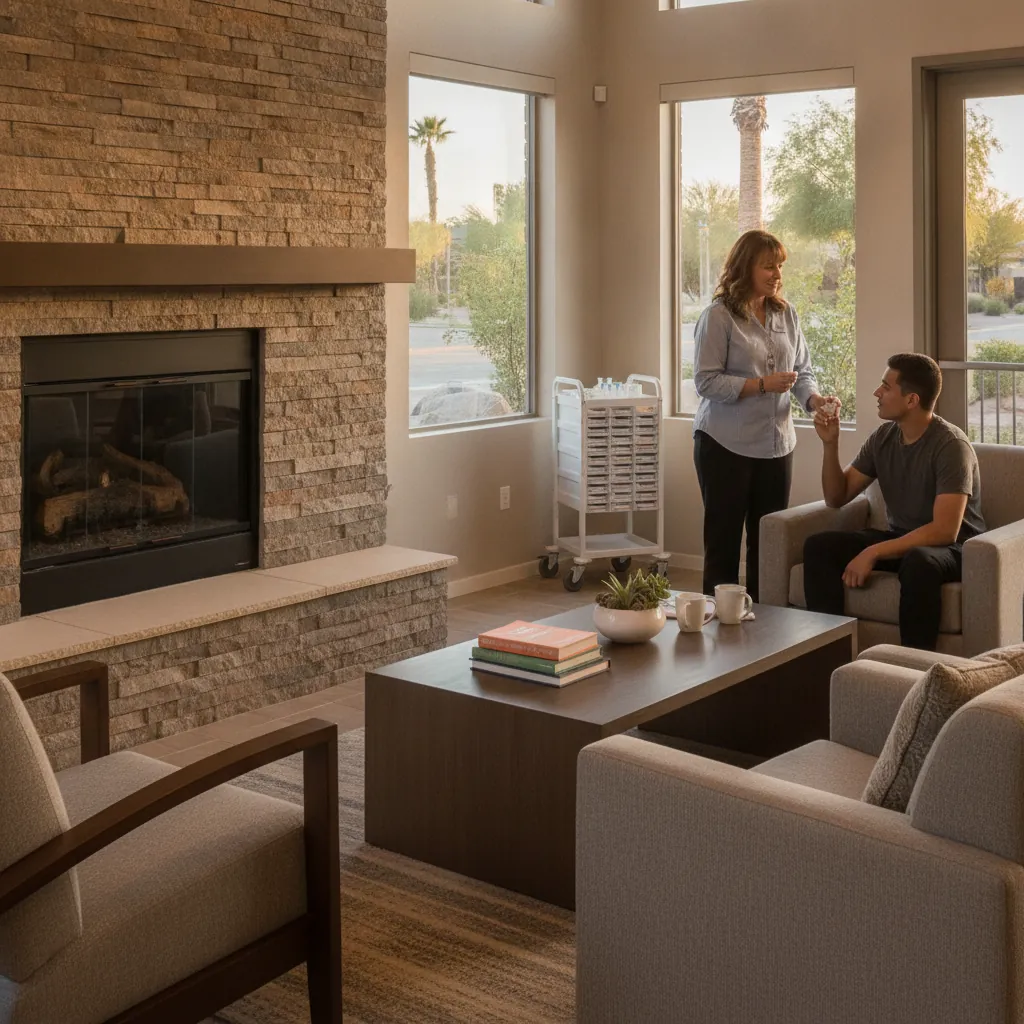
Medication management in a residential mental health program means that a licensed psychiatric provider — typically a psychiatrist or a psychiatric nurse practitioner — oversees every aspect of a resident’s psychiatric medications throughout their stay. This is not the same as a primary care doctor briefly adjusting a prescription. It’s a continuous clinical process that includes:
- A thorough psychiatric evaluation at or near admission to understand the resident’s full history
- Review of any medications already prescribed before admission
- Monitoring for effectiveness, side effects, and interactions
- Adjustments based on how the person is actually responding — week by week
- Documentation and coordination with the rest of the treatment team
- A discharge plan that ensures the person doesn’t leave without medications, prescriptions, and a follow-up appointment in place
For residents who come in without a clear diagnosis, or whose prior medications weren’t working well, this level of oversight can be genuinely life-changing. Psychiatric medication is not one-size-fits-all. Getting it right takes time, observation, and clinical expertise — all of which are available around the clock in a residential setting in ways that outpatient care simply cannot match.
Why This Matters More Than Most Programs Explain
One of the most significant gaps in how behavioral health programs — including many in the Glendale and Peoria areas — describe their services is that they treat medication management as a bullet point rather than a clinical cornerstone. You might see phrases like “medication oversight available” or “on-site nursing” without any explanation of what that means for the person sleeping there every night.
Here’s why it matters so much. Many people entering residential mental health treatment arrive in one of three situations:
- They’ve been on medications that stopped working — or were never right to begin with — and the crisis that landed them in care is partly the result of undertreated symptoms.
- They’ve been inconsistent with medications — sometimes by choice, sometimes because no one was helping them manage it — and their condition has destabilized significantly.
- They’ve never had a real psychiatric evaluation and are entering care without a clear clinical picture of what’s actually driving their symptoms.
In any of these situations, residential-level medication management is not a support service — it’s central to whether the person gets better.
What Happens to Current Medications at Admission?
This is one of the questions families ask most often, and it’s worth being direct about. When a resident enters a licensed BHRF, their current medications are typically reviewed by the facility’s psychiatric provider within the first day or two of admission. The provider will look at what they’re taking, why it was prescribed, whether there’s documentation from a prior provider, and how the person appears to be responding.
Medications are not automatically continued without review, and they are not automatically stopped either. The psychiatric provider makes a clinical determination. In many cases, a person’s current regimen is continued while the team gets to know them better. In other cases — particularly when someone was prescribed something by an emergency room physician or a primary care doctor who was working with limited information — there may be good reason to reassess.
Families are not left out of this process. If there are concerns about a specific medication or a history the clinical team should know about, that information should be shared at intake. Good programs treat the family’s knowledge of the person as a clinical asset.
How AHCCCS and Insurance Cover Medication Management
For residents covered by AHCCCS — Arizona’s Medicaid program — medication management by a licensed psychiatric provider is a covered service within residential behavioral health care. This includes the psychiatric evaluations, follow-up appointments with the prescribing provider during the stay, and in most cases, the medications themselves through the AHCCCS formulary.
Families who have been reluctant to pursue residential care because of concerns about cost should know that AHCCCS coverage can be quite comprehensive for individuals who qualify. The admissions process includes insurance verification, and authorization is coordinated through the relevant Regional Behavioral Health Authority (RBHA) — the regional organization that manages behavioral health services for AHCCCS members in Maricopa County. You don’t have to navigate that process alone.
If your loved one has commercial insurance rather than AHCCCS, medication management is typically covered as part of the residential benefit. Coverage specifics vary by plan, and the admissions team can help clarify what applies in your situation before a decision is made.
What Discharge Medication Planning Actually Involves
One of the places where residential programs most often fall short — and where families are most often left scrambling — is at the point of discharge. A person can spend weeks in a structured residential program making real progress, and then leave without a follow-up psychiatric appointment, without enough medication to bridge the gap, or without a clear plan for who manages their care next.
In a well-run BHRF, discharge planning around medications starts well before the day someone leaves. This means:
- Enough medication supplied at discharge to cover the transition period
- A follow-up appointment scheduled with an outpatient psychiatrist or prescriber before the resident walks out the door
- Documentation sent to the receiving provider so there’s no gap in the clinical picture
- Coordination with Adult Recovery Teams (ARTs) — community-based teams that provide ongoing behavioral health support — or outpatient case managers who will help the person stay on track
This kind of continuity is especially important for residents who are stepping down from residential care to outpatient services or supported housing. The weeks immediately following discharge are a high-risk window, and a solid medication plan is one of the most protective factors available.
Independent Living Skills and Medication Self-Management
For many residents — particularly those working toward greater independence — learning to manage their own medications is a skill that has to be taught, practiced, and supported. This is where independent living skills training connects directly to medication management.
Residential programs that integrate these two areas of care help residents understand what their medications do, why consistency matters, how to recognize side effects worth reporting, and how to refill prescriptions through AHCCCS or other coverage. These are practical skills — not clinical concepts — and building them during a residential stay means a person is better equipped when they’re living more independently in Phoenix, Avondale, or wherever home is next.
Frequently Asked Questions
Can my family member keep taking their current medications when they enter a residential program?
In most cases, yes — current medications are reviewed and typically continued at admission while the psychiatric provider completes a full evaluation. Adjustments are made clinically, not arbitrarily, and families are encouraged to share any relevant medication history at intake.
Is there a psychiatrist on-site in a licensed BHRF?
Licensed BHRFs are required to have psychiatric oversight, though the specific arrangement — whether a psychiatrist is on-site daily or available via telehealth with nursing staff present around the clock — varies by facility. At Bougainvillea Manor, psychiatric services are a core component of care, not an add-on.
Does AHCCCS cover psychiatric medications during a residential stay near Glendale?
For AHCCCS members, psychiatric medications on the covered formulary are typically included as part of residential behavioral health treatment. Your admissions coordinator can walk through what’s covered under your loved one’s specific AHCCCS plan before admission.
What if my loved one has been refusing to take medications? Can a residential program help?
Yes, and this is one of the areas where residential care has a meaningful advantage over outpatient treatment. Having daily clinical contact, consistent structure, and a psychiatric provider who can work through concerns about medications with the resident — rather than in a rushed 15-minute appointment — makes a real difference for people who have been resistant to treatment.
How do I make sure medication continuity is in place when my loved one is discharged?
Ask about discharge planning early, not just at the end of the stay. Specifically ask: Will they leave with enough medication to last until the first outpatient appointment? Is that appointment scheduled before discharge? Who is the outpatient prescriber, and will the residential team send records? These are reasonable questions, and a good program will have clear answers.
Take the Next Step for Your Loved One
If someone in your family is struggling — and you’re trying to figure out whether residential care is the right answer, or simply how the process works — you don’t have to sort through it alone. Bougainvillea Manor Behavioral Health serves adults across the Phoenix metro, including families coming from Glendale, Peoria, Avondale, and communities throughout Maricopa County.
Our team can answer your questions about medication management, walk you through the admissions process, and help you understand what AHCCCS or your commercial insurance covers. There’s no pressure, and no commitment required to have that first conversation.
Reach out to our admissions team today — we’re here to help you find the right level of care for the person you’re worried about.