
How Does Medication Management Work at a Residential Mental Health Facility — What Adults in Central Phoenix and Their Families Need to Know
If someone you love has been living with a serious mental health condition — bipolar disorder, schizophrenia, major depression, or something else entirely — there is a good chance that medication has been part of the picture. And there is also a good chance that getting medications right has been one of the hardest parts of this journey. For families in Central Phoenix and across the Maricopa County area, one of the most important questions before choosing a residential mental health facility is a simple one: who is going to be responsible for my loved one’s medications while they are there, and what happens when they leave? This guide answers that question honestly and clearly.
Why Medication Management Matters More Than Most Families Realize
Psychiatric medications can be genuinely life-changing — but they are rarely simple. Finding the right medication, at the right dose, with manageable side effects, often takes months of careful adjustment. When someone is in the middle of a mental health crisis, living in an unstable situation, or cycling in and out of emergency rooms, that careful process rarely happens the way it should.
Many of the adults who come to residential mental health treatment have medications that stopped working, were never quite right to begin with, were stopped abruptly, or were being taken inconsistently. Some are managing several prescriptions from different providers who are not coordinating with each other. Others have been self-medicating with substances to cope with symptoms that were never properly addressed. All of these situations call for something outpatient care often cannot provide: consistent, supervised, expert psychiatric oversight — every day, in a structured environment.
That is exactly what a licensed Behavioral Health Residential Facility, or BHRF — a type of licensed residential mental health program regulated by the Arizona Department of Health Services — is designed to provide.
What Medication Management Actually Looks Like Inside a Licensed BHRF
At a licensed facility like Bougainvillea Manor Behavioral Health in Phoenix, medication management is not an afterthought. It is woven into the daily structure of care from the moment a resident arrives.
Assessment and Review at Admission
When a new resident is admitted, one of the first steps is a thorough psychiatric evaluation. A qualified psychiatric provider reviews every medication the person is currently taking — including any medications prescribed by outside providers, anything obtained without a prescription, and any supplements that might interact with psychiatric medications. This is important because, in a crisis, the full medication picture is often incomplete or unclear.
Families in neighborhoods like Encanto or North Mountain Village often reach us after their loved one has been discharged from a hospital with a prescription they could not fill, or medications that were changed without follow-through. The admission assessment is the moment to catch all of that and start fresh with a clear, coordinated plan.
Daily Oversight and Safe Administration
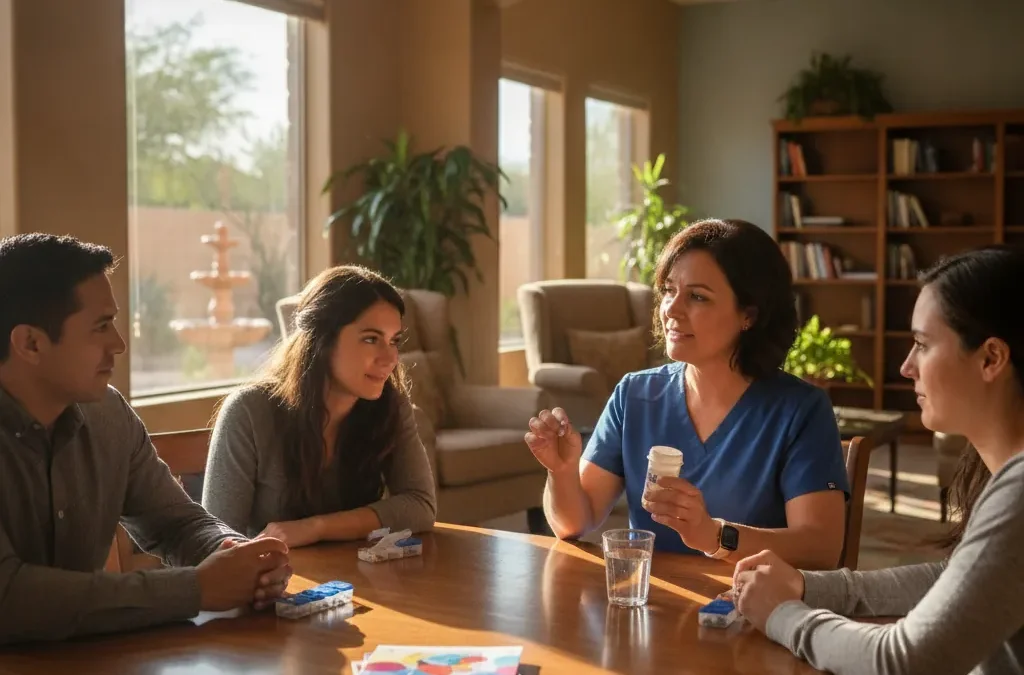
Inside a residential setting, medications are administered by trained staff on a consistent schedule. Residents are not left to self-manage medications they may have been struggling to take consistently on the outside. Staff observe and document whether medications are taken as prescribed — catching missed doses before they become a problem.
This level of daily oversight makes a meaningful difference for adults living with conditions like bipolar I or II, schizophrenia, or schizoaffective disorder, where missing even a few doses can tip someone back into acute crisis. It also provides a structured foundation for the therapeutic work happening alongside medication treatment — because therapy and skills work are far more effective when someone is psychiatrically stable.
Ongoing Psychiatric Monitoring and Adjustments
Residential treatment is not a static environment. As a resident stabilizes, their psychiatric provider continues to monitor symptoms, side effects, sleep patterns, and mood — adjusting medications as needed. This is the kind of close observation that an outpatient psychiatrist, who may see a patient for 20 minutes every few weeks, simply cannot provide.
For residents with co-occurring mental health and substance use disorders, this ongoing monitoring is especially important. Substances can mask or mimic psychiatric symptoms, so the picture of what medications are truly needed often becomes clearer as the person detoxes and stabilizes over the first several days and weeks of treatment.
A Gap Most Competitor Sites Don’t Address: What Happens to Medications at Discharge
One question families rarely think to ask — and that most competitor facilities barely address on their websites — is this: what happens to my loved one’s medications when they leave?
This is one of the most vulnerable moments in a person’s recovery. The transition from the structured, supported environment of residential treatment back to independent living — whether in Glendale, Mesa, or anywhere else in Maricopa County — is the period when medication discontinuity most often leads to relapse and rehospitalization.
A quality residential facility plans for this from day one. That means coordinating with the resident’s outpatient psychiatric provider — or helping connect them with one through the Regional Behavioral Health Authority (RBHA) system, which is the network of organizations contracted by AHCCCS, Arizona’s Medicaid program, to coordinate behavioral health services — before discharge, not the day of. It means ensuring the resident leaves with an adequate supply of medications, a clear understanding of how and when to take them, and a follow-up appointment already scheduled.
At Bougainvillea Manor, medication management does not stop at discharge planning — it is built into the entire arc of a resident’s stay, so that leaving feels like a handoff, not a cliff edge.
Teaching Residents to Manage Their Own Medications Over Time
For many adults in residential treatment, the long-term goal is not just stabilization — it is building the skills to manage their own mental health more independently. That includes understanding their own medications: what each one does, what side effects to watch for, and what to do if something does not feel right.
This kind of education is part of what the independent living skills component of residential care addresses — helping residents move from a place of confusion or passivity about their medications to one of informed self-advocacy. For adults preparing to return to the community in neighborhoods across Phoenix or in surrounding areas like Glendale, this knowledge is not optional. It is a core part of sustained recovery.
Does AHCCCS Cover Medication Management at a BHRF?
For residents covered by AHCCCS — Arizona’s Medicaid program — medication management services at a licensed BHRF are generally included as part of the covered residential treatment benefit. The specific authorization process varies based on the member’s RBHA, but medication management is considered an integral clinical service, not an add-on.
If you are unsure whether a loved one’s AHCCCS plan covers residential treatment at a facility like Bougainvillea Manor, the fastest way to find out is to contact us directly. Our admissions team works with families and referring providers across Maricopa County to verify coverage and navigate prior-authorization, so that questions about insurance do not become the reason someone delays getting help.
You can also verify insurance coverage through our website to get the process started.
Frequently Asked Questions
Can a resident continue taking the medications they were prescribed before entering residential treatment?
In most cases, yes — but this is reviewed carefully at admission. A psychiatric provider will evaluate all current medications, confirm they are appropriate given the person’s current condition, and make any adjustments needed. Families should bring a complete medication list, including doses and prescribing providers, when a loved one is admitted.
What if my loved one refuses to take their medications inside the facility?
Medication refusal is addressed therapeutically, not punitively. Staff are trained to understand and work through resistance, often rooted in side effects, distrust, or past negative experiences with medications. The psychiatric team can explore alternatives — including different medications or forms of administration — that a resident may be more willing to accept.
Will my family member’s outpatient psychiatrist be involved while they are in residential treatment?
Communication with outside providers is encouraged when appropriate and when the resident consents. The goal is coordination, not isolation. In practice, the residential psychiatric team takes primary responsibility for medication decisions during the stay, with a warm handoff back to the outpatient provider at discharge.
What happens if someone needs a medication that is not on the AHCCCS formulary?
AHCCCS does have a preferred drug list, but there are processes for requesting exceptions when a specific medication is clinically necessary. The psychiatric team at a licensed BHRF is familiar with these processes and can submit prior-authorization requests on a resident’s behalf.
Is it common for medications to change during a residential stay?
Yes — and for many residents, this is one of the most valuable parts of treatment. The combination of 24-hour observation, daily psychiatric monitoring, and a stable, substance-free environment gives providers much better information than they have in an outpatient setting. It is not unusual for a resident to leave with a meaningfully different — and more effective — medication regimen than the one they arrived with.
Taking the Next Step
If someone in your family is struggling — living in Central Phoenix, North Mountain Village, or anywhere across the Maricopa County area — and you have been wondering whether residential mental health treatment might help, we want to hear from you. The question about medications is one of many we are ready to answer, honestly and without pressure.
Bougainvillea Manor Behavioral Health offers licensed residential mental health treatment with comprehensive psychiatric and medication management services. Our team works with families, hospital discharge planners, RBHA coordinators, and Adult Recovery Teams (ARTs) to make the admissions process as clear and manageable as possible — even when everything feels urgent and uncertain.
Reach out to us through our contact page to speak with a member of our admissions team. You do not have to figure this out alone.