What Is DBT and How Does It Help Adults in Residential Mental Health Treatment in Avondale?
If your loved one has been discharged from a hospital, referred by a case manager, or has simply been in and out of crisis for months without lasting improvement, you may have heard the term DBT mentioned — and wondered what it actually means. Dialectical Behavior Therapy, or DBT, is a structured, evidence-based form of therapy originally developed for people who experience intense, overwhelming emotions. Today it is used widely in residential mental health programs across Phoenix and the surrounding West Valley to treat a range of conditions that have not responded well to other approaches. For families in Avondale, Goodyear, and nearby communities, understanding what DBT is — and what to look for when a program says it offers DBT — can genuinely change the outcome of a treatment search.
What DBT Actually Is — And What It Is Not
DBT was developed by psychologist Marsha Linehan in the late 1980s, originally for people with borderline personality disorder (BPD), a condition marked by extreme emotional swings, unstable relationships, impulsivity, and, in many cases, self-harm. What made DBT different from other therapies at the time was its explicit acknowledgment of a painful tension: the need to accept yourself exactly as you are right now, while also working hard to change behaviors that are hurting you. That balance — between acceptance and change — is the “dialectical” part of the name.
DBT is not a vague collection of coping tips. A full, evidence-based DBT program has four distinct skill modules:
- Mindfulness — learning to observe your thoughts and feelings without being swept away by them
- Distress Tolerance — getting through a crisis moment without making things worse
- Emotion Regulation — understanding why intense emotions happen and building skills to manage them
- Interpersonal Effectiveness — asking for what you need, setting limits, and maintaining relationships without losing yourself
These skills are taught in group settings, practiced in individual therapy, and — in a well-run residential program — reinforced throughout daily life in the facility. That last part matters. Skills learned in a one-hour outpatient session once a week are far harder to internalize than skills practiced every day in a structured, supportive environment.
Who DBT Is Designed to Help
DBT was built for borderline personality disorder, but its evidence base has expanded considerably. Today, DBT is used — and shown to be effective — for adults dealing with:
- Borderline personality disorder and other personality disorders
- Chronic self-harm or suicidal thoughts
- Post-traumatic stress disorder (PTSD), particularly complex trauma
- Severe depression that has not responded to medication alone
- Eating disorders with emotional dysregulation at the core
- Co-occurring substance use and mental health conditions — sometimes called dual diagnosis
If your loved one has been described as “treatment-resistant,” has cycled through multiple hospitalizations, or has a pattern of emotional crises that no one has been able to get ahead of, DBT may be the approach that has been missing from their care. That said, it is not a quick fix. Residential treatment gives it the time and structure it needs to actually take hold.
Why DBT Works Better in a Residential Setting Than Outpatient
This is the part that most competitor websites in the Phoenix area gloss over — and it is genuinely important for families to understand before they start comparing programs.
Outpatient DBT typically means one individual therapy session per week plus a weekly skills group. For someone who is in acute crisis, living in an unsafe environment, or struggling with co-occurring substance use, that level of support is often not enough. The gap between sessions is where crises happen. Skills fade before they are practiced. Triggers at home undo the work done in the office.
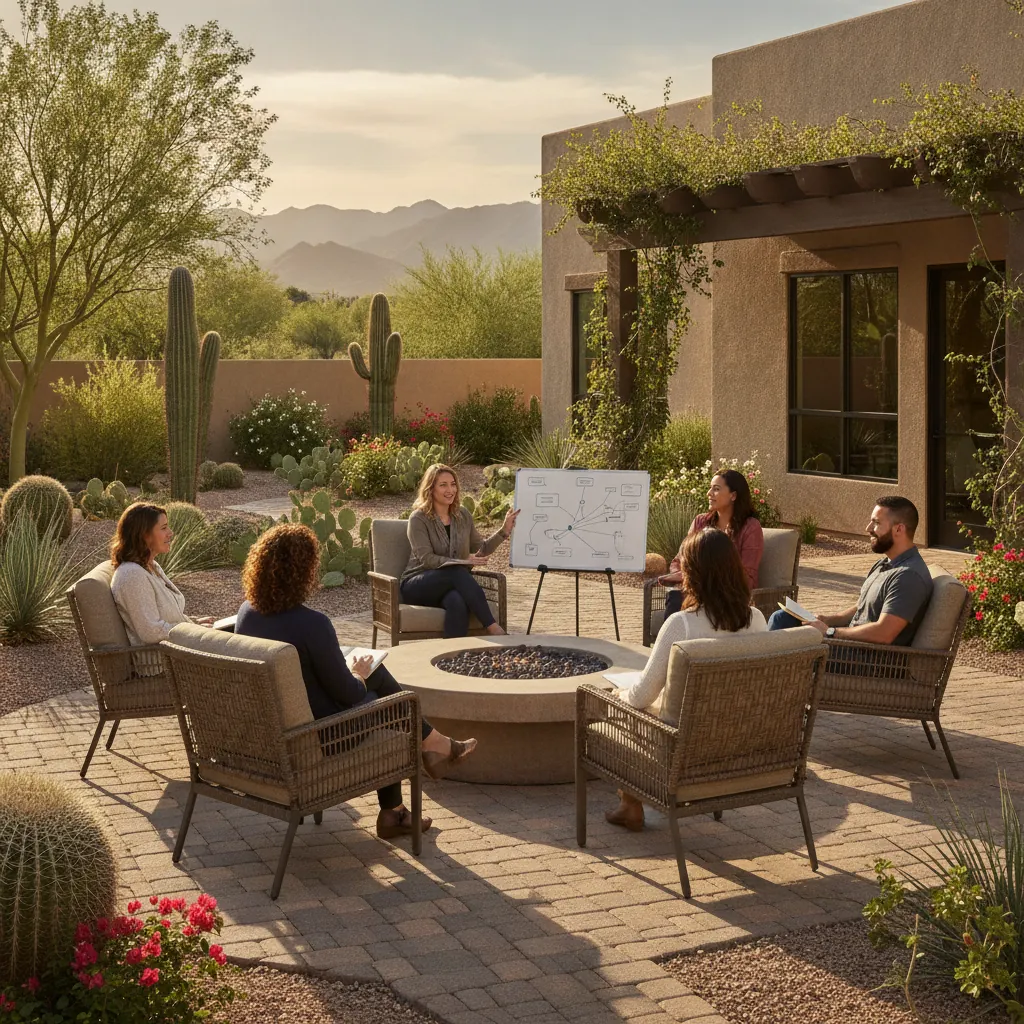
Residential treatment in a licensed Behavioral Health Residential Facility — a BHRF, as these programs are known under Arizona Department of Health Services (ADHS) licensure — provides something outpatient simply cannot: a safe, structured environment where DBT skills are not just taught but lived. Meals, group interactions, sleep schedules, conflict resolution with peers, daily check-ins with clinicians — all of it becomes an opportunity to practice the same skills being taught in formal DBT groups. That repetition is not incidental. It is the mechanism by which DBT works.
At Bougainvillea Manor Behavioral Health in Phoenix, behavioral health residential treatment provides exactly this kind of structured daily environment — 24-hour support from trained staff, integrated clinical programming, and the consistency that skills-based therapies like DBT require to be effective.
What to Ask a Program Before Assuming They Offer “Real” DBT
In the West Valley — including Avondale, Goodyear, and communities along the Interstate 10 corridor — families searching for residential mental health programs sometimes discover that a facility’s website says “DBT” but the actual implementation is minimal: perhaps a single skills workbook or a once-weekly group led by a staff member with no DBT-specific training. That is not comprehensive DBT. It is DBT in name only.
Here are honest questions to ask any program you are considering:
- Do your DBT groups cover all four skill modules — mindfulness, distress tolerance, emotion regulation, and interpersonal effectiveness?
- Are individual therapists trained specifically in DBT, or is it offered only in group format?
- How is DBT integrated into the daily structure of the program, outside of scheduled group time?
- Do staff receive ongoing DBT consultation and supervision?
- How do you adapt DBT for residents with dual diagnosis — co-occurring mental health and substance use issues?
A program that can answer those questions clearly and confidently is one worth a deeper conversation. One that hedges or pivots quickly to other topics may not have the clinical depth being advertised.
DBT, Dual Diagnosis, and the Reality of Co-Occurring Conditions
Many adults who need DBT also struggle with substance use. The emotional dysregulation that DBT addresses is frequently what drives people toward alcohol or drugs in the first place — substances become a way to manage feelings that feel unmanageable. That is why DBT in a dual diagnosis treatment setting is so important. Treating the substance use without addressing the underlying emotional regulation deficits leaves a critical gap. Treating the emotional dysregulation without acknowledging the role substances have played ignores reality.
A well-designed residential program serving Maricopa County residents will hold both of those truths at once — offering integrated care that addresses mental health and substance use together, with DBT as one of the core clinical tools.
Does AHCCCS Cover DBT in a Residential Program?
AHCCCS — Arizona Health Care Cost Containment System, which is Arizona’s Medicaid program — does cover residential behavioral health treatment in licensed BHRFs for qualifying adults. DBT is not billed as a separate line item; it is part of the clinical programming within a covered residential stay. If your loved one qualifies for AHCCCS and meets clinical criteria for residential level of care, the cost of treatment, including the therapies delivered during that stay, is typically covered.
The process involves coordination through a Regional Behavioral Health Authority, or RBHA — the contracted organization that manages AHCCCS behavioral health benefits in your region. For most of Maricopa County, including communities like Avondale and Goodyear, that is Mercy Maricopa Integrated Care. Referrals can also come through Adult Recovery Teams (ARTs) — mobile teams that work with adults with serious mental illness — or through Child and Family Teams (CFTs) for transitional-age youth. If you are working with a hospital discharge planner or case manager, they can often initiate the prior authorization process directly.
For a clearer picture of what coverage may look like for your specific situation, you can verify insurance coverage directly through Bougainvillea Manor — it is a simple first step that costs nothing and gives you real information rather than estimates.
Frequently Asked Questions About DBT and Residential Mental Health Care Near Avondale
Is DBT only for borderline personality disorder?
No. While DBT was originally developed for BPD, it is now used effectively for PTSD, chronic depression, self-harm, eating disorders, and co-occurring substance use. If emotional dysregulation is part of the picture, DBT is likely relevant.
How long does DBT take to work?
A full outpatient DBT program typically runs six months to a year. In a residential setting, the intensive daily structure compresses learning significantly — many residents begin to internalize and use skills within weeks. But residential treatment is a starting point, not the whole journey; continuing DBT skills work after discharge is important for lasting results.
What if my loved one refuses therapy? Can DBT still help?
Resistance to therapy is common, especially early in treatment. A skilled residential team works with that resistance rather than against it. DBT’s acceptance-based framework is actually well-suited to people who have felt judged or failed by previous treatment. Many residents who arrive skeptical engage more deeply once they experience the difference.
Can someone from Avondale or Goodyear be admitted to a residential program in Phoenix?
Yes. Residential programs in Phoenix routinely serve residents from across Maricopa County. Transportation or proximity concerns can be addressed during the admissions process. AHCCCS coverage is not restricted by which city you live in, only by the licensure and authorization status of the facility.
Is there a difference between a licensed BHRF and a sober living home?
Yes — and it is an important one. A licensed BHRF is an Arizona Department of Health Services-licensed facility with 24-hour clinical staff, structured programming, psychiatric oversight, and accountability to specific care standards. A sober living home is a peer-supported, unlicensed (or minimally licensed) housing option. They serve different needs, and only a BHRF provides the level of clinical care that qualifies for AHCCCS coverage.
Taking the Next Step for Your Loved One
If you are in Avondale, Goodyear, West Phoenix, or anywhere else in the West Valley and you are trying to figure out whether DBT-informed residential treatment is right for the person you love, you do not have to sort through all of this alone. Bougainvillea Manor Behavioral Health in Phoenix works with families, case managers, hospital discharge planners, and RBHA referral teams every day to find the right level of care and navigate the process from first call to admission.
Reach out to our team through our contact page to ask questions, get a clearer sense of what treatment looks like, or begin the admissions process. There is no obligation, and no question is too small when the stakes feel this high.