
How Does Trauma-Informed Care Actually Work Inside a Residential Mental Health Facility — A Guide for Families in Chandler and the East Valley
If someone you love has experienced trauma — whether from childhood abuse, domestic violence, a serious accident, military service, or years of chronic stress — you probably already sense that ordinary care won’t be enough. You may be asking: will a residential facility actually understand what my family member has been through? Will the way they run things there help, or accidentally make things worse? These are exactly the right questions, and families in Chandler, Mesa, Tempe, Gilbert, and across the East Valley deserve clear, honest answers. Trauma-informed care is not a single therapy technique. It is a whole way of organizing a treatment environment — from how staff greet someone on their first day to how conflicts are handled at 2 in the morning. This guide explains what it actually looks like in practice, and what to ask when you’re evaluating a licensed residential facility.
Why Trauma Is So Central to Residential Mental Health Care
Research consistently shows that a significant portion of adults seeking residential mental health treatment have experienced at least one major traumatic event — and many have experienced several. Trauma does not always look like what people expect. It doesn’t require a single dramatic event. It can come from years of emotional neglect, from living in an unsafe neighborhood, from losing a parent too young, or from a pattern of relationships that felt dangerous. When trauma goes unrecognized and untreated inside a mental health facility, even well-intentioned care can feel threatening to the person receiving it — triggering shame, shutting down progress, or causing someone to leave treatment early.
A trauma-informed residential program recognizes this reality and builds its entire environment around one core question: What happened to this person? — rather than What is wrong with this person? That shift in framing changes everything about how care is delivered.
What Trauma-Informed Care Looks Like Day to Day in a Licensed BHRF
A licensed Behavioral Health Residential Facility, or BHRF — a state-licensed, 24-hour structured living and treatment environment regulated by the Arizona Department of Health Services — is where trauma-informed principles matter most. Unlike a weekly outpatient appointment, residential treatment is someone’s entire daily environment. Every interaction, every schedule change, every staff response to a difficult moment is either healing or harmful, depending on how the program is designed.
In a genuinely trauma-informed BHRF, you would expect to see the following in practice:
- Safety as the foundation. Physical and emotional safety are treated as non-negotiable preconditions for healing — not just a baseline assumption. This means clear, consistent routines so residents always know what to expect; private spaces where someone can decompress; and staff who are trained to recognize when a resident is becoming overwhelmed and respond calmly rather than reactively.
- Choice and control built into daily life. Trauma often involves powerlessness — having control taken away. A trauma-informed program deliberately restores small choices wherever possible: what to eat from available options, when to talk and when to rest, how to engage in group activities. This is not permissiveness; it is intentional therapeutic design.
- Staff trained to recognize trauma responses. Behaviors that might look like defiance, manipulation, or non-compliance — shutting down, lashing out, refusing to participate — are often trauma responses. Staff in a trauma-informed program are trained to see beneath the behavior and respond with curiosity rather than punishment.
- Evidence-based therapies adapted for trauma. This typically includes Cognitive Behavioral Therapy (CBT) adapted to address trauma-distorted thinking patterns, Dialectical Behavior Therapy (DBT) to build distress tolerance and emotional regulation skills, and trauma-specific approaches that allow residents to process difficult experiences at a pace that feels manageable — never forced.
- Peer community that does not re-traumatize. Group therapy and shared living spaces carry their own risks for trauma survivors. A well-run program actively monitors group dynamics, sets clear expectations about how residents treat one another, and steps in quickly when someone’s experience is being minimized or dismissed.
The Gap Most Competitor Programs Leave Unfilled
When reviewing how residential mental health programs in the Phoenix area describe their approach online, a pattern stands out: many list “trauma-informed care” as a service without explaining what it means in practice. A family reading those sites has no way to tell whether the program genuinely integrates trauma principles across the full residential environment — or whether it simply offers one trauma-focused group per week alongside a conventional program structure. That distinction matters enormously for the person in your family who is deciding whether to trust this place with their healing.
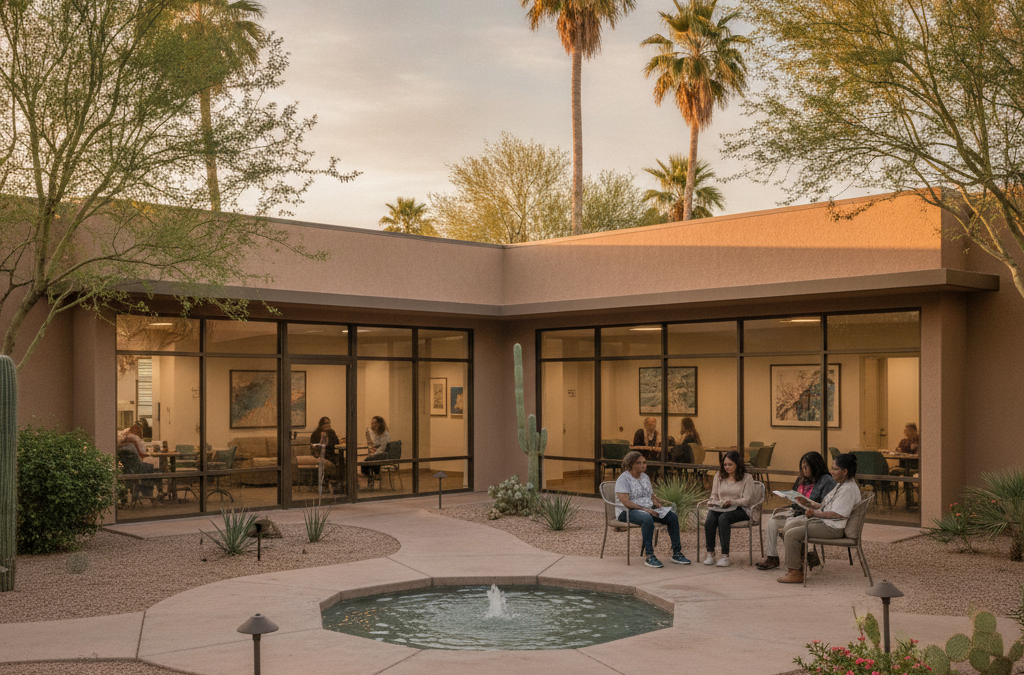
The questions to ask when you call any residential program in the East Valley or anywhere in Maricopa County are specific: How do staff respond when a resident is triggered during a group session? How is the physical environment designed to feel safe rather than institutional? What training do direct-care staff — not just therapists — receive in trauma-informed approaches? What happens if someone’s trauma history makes a standard group format feel unsafe for them?
A program that can answer those questions clearly and specifically is one worth trusting. Learn more about how Bougainvillea Manor approaches mental health treatment for adults with complex histories.
Trauma, Dual Diagnosis, and Why They Almost Always Go Together
For many adults — in Chandler and across Maricopa County — trauma and substance use are tangled together. Alcohol, opioids, cannabis, methamphetamine: these are often used, initially, as attempts to manage the emotional pain that untreated trauma creates. When someone enters a residential facility for both a mental health condition and a substance use disorder, this is called dual diagnosis, or co-occurring disorders. A program that only addresses the substance use without addressing the underlying trauma is leaving the most important work undone.
A trauma-informed dual diagnosis program treats both simultaneously, recognizing that they reinforce each other and that healing one requires working on both. This integrated approach is not universal — it requires specific clinical infrastructure, staff training, and program design. When you’re evaluating facilities, ask directly whether the clinical team addresses trauma history as part of the dual diagnosis treatment plan, not as a separate add-on.
Does AHCCCS Cover Trauma-Informed Residential Treatment?
AHCCCS — Arizona’s Medicaid program, the Arizona Health Care Cost Containment System — does cover residential mental health treatment at licensed BHRFs for eligible adults, including treatment that addresses trauma as part of a broader mental health or dual diagnosis treatment plan. Coverage is coordinated through a Regional Behavioral Health Authority, or RBHA — the managed care organization that authorizes and oversees behavioral health services for AHCCCS members in your region. For most adults in Maricopa County, that RBHA is Mercy Care.
The authorization process can feel complicated, especially when you’re already exhausted and scared. A good residential program will walk you through this — verifying your loved one’s AHCCCS coverage, coordinating with the RBHA, and handling the prior-authorization paperwork on your behalf. You should not have to navigate that system alone. See what insurance Bougainvillea Manor accepts, including AHCCCS and commercial plans.
Frequently Asked Questions
Does my family member have to talk about their trauma right away in residential treatment?
No. A trauma-informed program moves at the resident’s pace. The early phase of residential treatment typically focuses on stabilization — creating safety, establishing routine, and building trust with staff and the clinical team. Deeper trauma processing, if it happens at all during the residential stay, comes later and is never forced. For many people, the residential phase is about building the foundation that makes trauma processing possible in step-down care afterward.
What if my loved one in Mesa or Gilbert has PTSD and bipolar disorder — can a residential facility treat both?
Yes, and this combination is more common than many families realize. A qualified residential mental health facility can provide integrated treatment for PTSD and bipolar disorder simultaneously, including psychiatric medication management, individual therapy, and skills-based group work. The clinical team develops an individualized treatment plan that accounts for how these conditions interact in this specific person’s life.
How do I know if a residential program in the Phoenix area is truly trauma-informed, or just using the term?
Ask specific operational questions: What training do direct-care staff receive in trauma-informed approaches? How does the program handle a resident who becomes dysregulated during a group? Is the physical environment designed with trauma sensitivity in mind? A program that can give you concrete, specific answers is demonstrating real integration. Vague responses like “we take a holistic approach” are a sign to dig deeper.
Can a family member be involved in trauma-informed care during residential treatment?
Family involvement is encouraged in many trauma-informed programs, though the form it takes depends on the individual’s treatment plan and their own readiness. In some cases, family sessions are a meaningful part of treatment. In others, the most important thing family members can do is allow their loved one space to stabilize without added pressure. The clinical team can help you understand what role is most helpful for your specific situation.
Is there a wait for residential mental health placement in the East Valley?
Licensed BHRF beds across Maricopa County are in high demand relative to the available supply, and families in Chandler, Tempe, and Mesa often arrive in urgent situations needing same-day or next-day placement. Calling early — even before a crisis reaches its peak — gives your family more options. Many programs, including Bougainvillea Manor, can conduct an admissions screening quickly and provide a clear picture of availability and next steps.
Taking the Next Step
You don’t have to figure this out alone. If someone you love in Chandler, Mesa, Tempe, or anywhere across the East Valley is struggling — and if trauma is part of what they’re carrying — Bougainvillea Manor Behavioral Health is here to talk through what residential care might look like for them. Our team understands the complexity of trauma, the urgency that families feel, and the practical realities of navigating AHCCCS and the Maricopa County behavioral health system. Reach out to us today to speak with someone on our admissions team, verify insurance, or simply ask questions. You deserve honest answers, and your family member deserves care that sees the whole person.